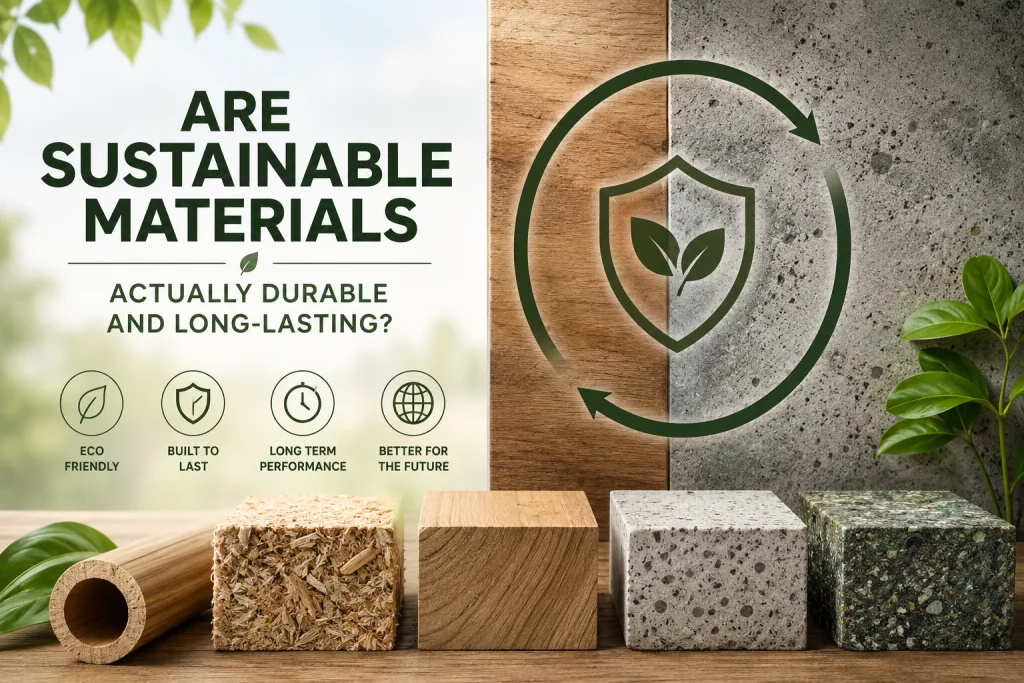
Are Sustainable Materials Actually Durable and Long-Lasting?
Are Sustainable Materials Actually Durable and Long-Lasting?
For decades, the construction industry has operated under a deeply ingrained assumption: traditional materials like virgin steel, Portland cement concrete, and old-growth timber are the gold standards for durability. When sustainable alternatives first entered the market, they were often met with skepticism.
The prevailing question among architects, engineers, and developers has been: "Are sustainable materials actually durable and long-lasting, or are we sacrificing structural integrity for environmental optics?"
These quality and longevity concerns are entirely valid. A building’s lifespan is its ultimate measure of sustainability; a structure that needs to be replaced or heavily repaired after 20 years is a failure, regardless of its carbon footprint.
Today, however, material science has evolved. Let’s dismantle the myths, address the legitimate concerns regarding quality, and explore how modern sustainable materials are redefining longevity in the built environment.
The Root of the Skepticism: Why Do We Doubt Green Materials?
To address quality and longevity concerns, we must first understand where they come from. The skepticism in the construction industry usually stems from three factors:
- Early "Greenwashing" and First-Generation Products: In the early 2000s, some sustainable products prioritized eco-credentials over performance. Early iterations of recycled plastic lumber, for example, warped under UV exposure, and some bio-based insulations suffered from moisture degradation.
- Misapplication of Materials: Many failures of sustainable materials are not due to the material itself, but improper specification. Using a material outside of its intended environmental or structural parameters will result in failure, regardless of whether the material is virgin or recycled.
- The "Recycled = Inferior" Bias: There is a persistent psychological bias that recycled or repurposed materials are inherently weaker than virgin materials.
However, the narrative has shifted. Modern sustainable materials are engineered for performance first, with sustainability as a built-in benefit.
Redefining Durability: Sustainable Materials That Outperform
When specified and installed correctly, many sustainable materials do not just match traditional counterparts—they exceed them in longevity and resilience.
1. Mass Timber (CLT and Glulam)
The Concern: Wood is a fire hazard and susceptible to rot. The Reality: Engineered mass timber, such as Cross-Laminated Timber (CLT), is incredibly durable. In fire scenarios, mass timber performs predictably and safely; it chars on the outside, creating an insulating layer that protects the structural core. Furthermore, because it is engineered to precise moisture contents and often utilized in controlled building envelopes, its risk of rot or pest infestation is vastly lower than traditional stick framing.
2. Geopolymer and Green Concrete
The Concern: Concrete without high amounts of Portland cement won't achieve the necessary PSI or lifespan. The Reality: Green concretes, which utilize supplementary cementitious materials (SCMs) like fly ash, slag, or calcined clays, often result in a denser, less permeable final product. This lower permeability makes green concrete highly resistant to chloride ingress and sulfate attack, significantly extending the lifespan of structures in harsh environments, such as marine applications or areas using de-icing salts.
3. Recycled Steel and Composite Rebar
The Concern: Recycled metals lose their tensile strength. The Reality: Steel is infinitely recyclable without any loss of strength. Modern electric arc furnaces (EAF) produce recycled steel that meets the exact same ASTM standards as virgin steel. Furthermore, sustainable alternatives like Glass Fiber Reinforced Polymer (GFRP) rebar offer a non-corrosive alternative to traditional steel rebar, drastically extending the lifecycle of concrete structures by eliminating rust-jacking.
4. High-Density Bamboo and Engineered Cork
The Concern: Bio-based finishes and flooring will wear out quickly. The Reality: Strand-woven bamboo has a Janka hardness rating that exceeds many traditional hardwoods like red oak and maple. Similarly, high-density engineered cork is highly resilient, compressible, and naturally resistant to mold and mildew, making it a long-lasting flooring and acoustic solution.
Shifting the Paradigm: Life-Cycle Cost vs. First Cost
To truly evaluate the longevity of sustainable materials, the construction industry must shift its focus from Initial First Cost to Life-Cycle Cost (LCC).
A sustainable material might carry a 5% to 15% premium at the procurement stage. However, if that material requires zero chemical sealing, resists UV degradation, lowers HVAC loads through superior thermal mass, and extends the maintenance cycle by a decade, the ROI is undeniable. True longevity in construction is measured by the total cost of ownership over a 50- to 100-year horizon.
Best Practices for Ensuring Quality and Longevity
For contractors, project managers, and specifiers, ensuring that sustainable materials perform as advertised requires rigorous quality control. Here is how to mitigate longevity concerns on your next project:
- Demand Transparency and EPDs: Require Environmental Product Declarations (EPDs) and comprehensive technical data sheets. Do not accept "green" claims without backing data regarding the material's expected lifespan and maintenance requirements.
- Master Moisture Management: Water is the enemy of all buildings, but particularly bio-based sustainable materials. Ensure your building envelope designs, flashing details, and vapor barriers are flawless. Proper detailing is the key to longevity.
- Follow Manufacturer Specifications to the Letter: Sustainable materials often have unique installation requirements (e.g., specific fasteners for composite materials, or acclimation times for mass timber). Deviating from the manufacturer's guidelines voids warranties and guarantees premature failure.
- Vet the Supply Chain: Work with established manufacturers who have a proven track record. The sustainable materials market is growing, and it is vital to partner with suppliers who subject their products to rigorous, third-party accelerated aging and structural testing.
Are sustainable materials actually durable and long-lasting? Yes.
The quality and longevity concerns that once plagued the green building movement are largely a relic of the past. Today, sustainable materials are engineered to withstand the rigors of time, weather, and use. In many cases, they offer superior resistance to fire, corrosion, and environmental degradation compared to their traditional counterparts.
Found this article valuable?
Share it with fellow builders, architects, or download the QR code.
Written by Shanmugam2026
Verified CreatorARQONZ Editorial Team brings you expert insights, construction guides, and architectural design trends from across the building industry.
Related Articles in Construction
What Should I Never Say to My Contractor?