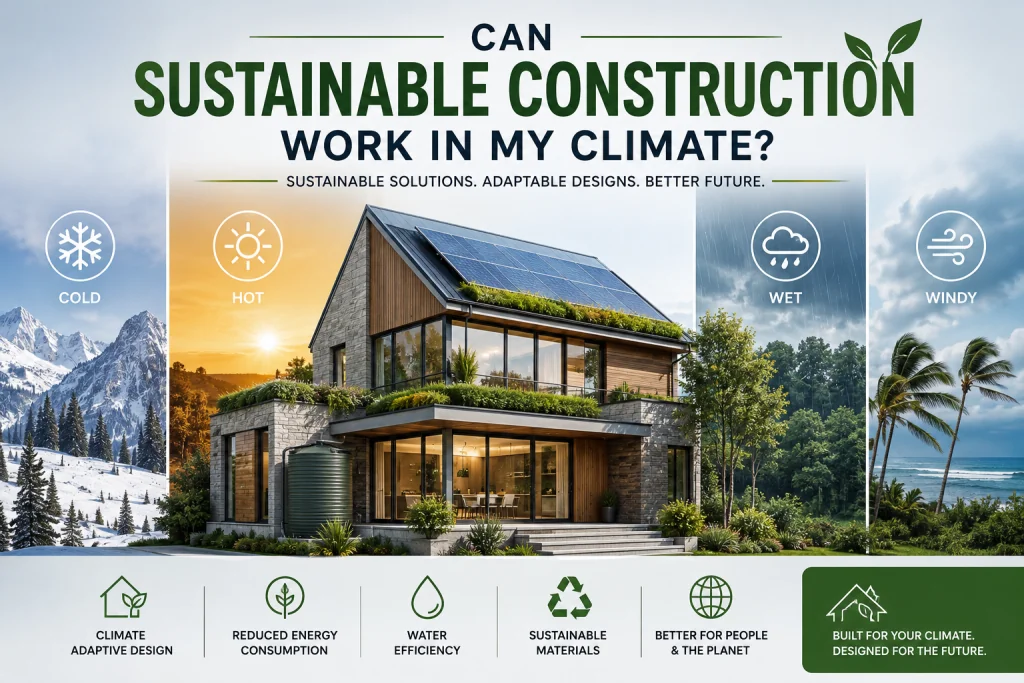
Can Sustainable Construction Work in My Climate?
Can Sustainable Construction Work in My Climate?
Meta Description: Discover how sustainable construction adapts to diverse weather conditions. Explore the regional applicability and feasibility of green building practices for construction professionals.
As the construction industry races to meet 2030 carbon reduction targets, sustainable building has transitioned from a niche preference to a baseline expectation. Yet, as developers, contractors, and architects evaluate green building mandates, one critical question consistently arises on the job site and in the boardroom:
"Can sustainable construction actually work in my specific climate?"
The short answer is an emphatic yes. However, the long answer requires a nuanced understanding of regional applicability and feasibility. A passive solar design that yields massive energy savings in the arid Southwest will fail miserably in the humid Southeast. True sustainability isn’t about applying a universal checklist; it’s about contextual adaptation.
Here is a comprehensive look at how sustainable construction scales across different climate zones, and how industry professionals can evaluate the feasibility of green practices in their specific regions.
The Fallacy of "One-Size-Fits-All" Green Building
In the early days of the green building movement, there was a temptation to copy-paste successful sustainable designs from one region to another. This approach often led to building envelope failures, skyrocketed HVAC loads, and compromised indoor air quality.
Today, industry leaders recognize that regional applicability is the cornerstone of effective sustainable construction. The climate dictates the primary environmental loads a building must resist—be it solar heat gain, freezing temperatures, or driving rain. Therefore, the feasibility of a sustainable strategy depends entirely on its alignment with local meteorological realities.
Regional Applicability: Tailoring Sustainability to the Climate
To achieve optimal feasibility, construction strategies must be mapped to specific climate zones. Here is how sustainable construction adapts across four primary climate profiles:
1. Hot and Arid Climates (e.g., US Southwest, Middle East, Central Australia)
- The Challenge: Extreme diurnal temperature shifts, intense solar radiation, and water scarcity.
- Sustainable Strategies:
- Thermal Mass: Utilizing materials like rammed earth, concrete, or adobe to absorb heat during the day and release it at night.
- Passive Cooling & Shading: Deep overhangs, louvers, and strategic building orientation to block high-angle summer sun.
- Cool Roofs: High-albedo reflective roofing materials to minimize the urban heat island effect and reduce cooling loads.
- Water Feasibility: Xeriscaping and greywater recycling systems are highly feasible and essential in these regions.
2. Cold and Snowy Climates (e.g., Northern US, Canada, Scandinavia)
- The Challenge: Prolonged freezing temperatures, high heating demands, and potential for condensation/mold within walls.
- Sustainable Strategies:
- Super-Insulation & Airtightness: Maximizing the R-value of the building envelope and utilizing advanced air-barrier systems to prevent thermal bridging and heat loss.
- Passive Solar Gain: South-facing glazing (in the Northern Hemisphere) to capture low-angle winter sun, reducing reliance on mechanical heating.
- High-Performance Fenestration: Triple-pane, argon-filled windows with low-E coatings are not just a luxury here; they are a feasibility requirement to prevent interior condensation.
- Heat Recovery: Energy Recovery Ventilators (ERVs) are critical to maintain indoor air quality without exhausting heated air.
3. Hot and Humid Climates (e.g., US Southeast, Gulf Coast, Tropical Regions)
- The Challenge: High moisture loads, intense cooling demands, and high risks of biological growth (mold/mildew).
- Sustainable Strategies:
- Moisture Management: The building envelope must be designed to dry to the exterior. Vapor retarders must be placed on the warm side of the insulation to prevent interstitial condensation.
- Cross-Ventilation: Designing for natural airflow to reduce mechanical cooling loads during shoulder seasons.
- Elevated Structures: In flood-prone coastal areas, elevating the structure not only mitigates flood risk but also allows for under-floor ventilation.
- Dehumidification: Dedicated outdoor air systems (DOAS) are highly feasible here to manage latent heat loads independently of sensible cooling.
4. Temperate and Mixed Climates (e.g., Pacific Northwest, parts of Europe)
- The Challenge: Moderate but highly variable conditions requiring both heating and cooling throughout the year.
- Sustainable Strategies:
- Adaptive Envelopes: Operable shading devices and dynamic facades that respond to shifting seasonal conditions.
- Daylighting: Maximizing natural light to reduce electrical loads, utilizing light shelves and clerestory windows.
- Balanced Insulation: Moderate, continuous insulation that prevents summer overheating while retaining winter heat.
Evaluating Feasibility: The Business Case for Localized Sustainability
Understanding the technical application is only half the battle. For construction executives and project managers, feasibility comes down to supply chains, local codes, and the bottom line.
When evaluating if a sustainable strategy is feasible for your next project, consider these three pillars:
1. Material Sourcing and Embodied Carbon A sustainable material is only truly sustainable if it doesn't require massive carbon emissions to transport to your job site. Feasibility relies on local supply chains. Sourcing regional timber, local aggregates, or locally manufactured low-carbon concrete drastically reduces embodied carbon and protects your project from global supply chain disruptions.
2. Local Codes and Incentives Regional applicability is heavily influenced by local jurisdiction. Some municipalities have adopted stringent, climate-specific energy codes (like Title 24 in California), while others offer aggressive tax incentives for specific technologies, such as geothermal heat pumps or solar-ready roofing. Aligning your sustainable design with local incentives drastically improves financial feasibility.
3. Lifecycle Cost vs. Upfront Capital In extreme climates, the upfront cost of high-performance building envelopes or advanced HVAC systems is easily justified by the lifecycle energy savings. In milder climates, the feasibility of expensive, cutting-edge green tech might be harder to justify. Construction professionals must run localized Lifecycle Cost Analyses (LCCA) to prove ROI to stakeholders.
Actionable Takeaways for Construction Professionals
To ensure your next project is both sustainable and feasible, implement the following steps during the pre-construction phase:
- Conduct a Micro-Climate Analysis: Don't just rely on broad climate zone data. Use localized weather files and site-specific analysis to understand wind patterns, sun paths, and historical precipitation.
- Prioritize the Building Envelope First: Before specifying expensive mechanical systems or solar arrays, optimize the passive design. A well-designed, climate-appropriate envelope reduces the size (and cost) of the required HVAC equipment.
- Engage Local Subcontractors Early: Sustainable construction requires precise execution. Engage local trades early in the design-build process to ensure they understand the specific air-sealing, insulation, or moisture-management details required for your climate.
- Utilize Climate-Specific Certification Frameworks: While LEED and BREEAM are excellent, look into localized rating systems (like IGBC in India, Green Star in Australasia, or local Living Building Challenge equivalents) that are specifically calibrated to regional ecological realities.
Can sustainable construction work in your climate? Absolutely. But it requires abandoning the idea of a universal "green" template.
By focusing on regional applicability and feasibility, the construction industry can move past performative sustainability. When we design with the local climate rather than against it, we create buildings that are not only environmentally responsible but also more resilient, cost-effective, and comfortable for the end user.
Sustainability isn't a single destination; it's a localized journey. And with the right regional strategies, every job site can be part of the solution.
Found this article valuable?
Share it with fellow builders, architects, or download the QR code.
Written by Shanmugam2026
Verified CreatorARQONZ Editorial Team brings you expert insights, construction guides, and architectural design trends from across the building industry.
Related Articles in Construction

What Should I Never Say to My Contractor?