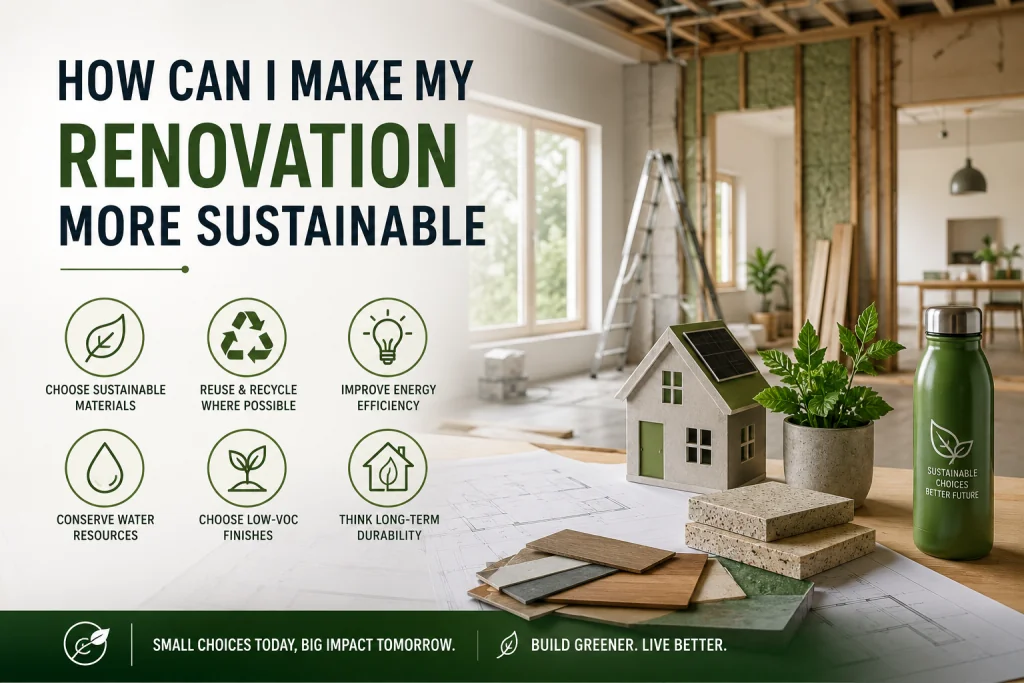
How Can I Make My Renovation More Sustainable?
How Can I Make My Renovation More Sustainable?
In the construction industry, the spotlight often falls on new builds when we talk about green design. However, as we move deeper into 2026, the industry reality is clear: the most sustainable building is often the one that already exists.
Adaptive reuse and renovations are booming, but integrating sustainability into an existing project comes with a unique set of constraints. You are working within an established envelope, dealing with legacy systems, and managing tight scopes.
So, how can project managers, contractors, and developers make an existing renovation more sustainable without blowing up the budget or schedule? Here are the practical, industry-tested steps to green your next retrofit.
1. Audit Before You Demo: Preserve Embodied Carbon
The most significant environmental impact of a renovation often happens before the first new material is ordered. Demolition wastes the "embodied carbon" already locked into the existing structure.
- Conduct a Structural & Material Audit: Before finalizing the demolition scope, assess what can be salvaged. Preserving existing concrete slabs, structural steel, and brickwork drastically reduces the need for new, carbon-intensive materials.
- Shift to Deconstruction: Where demolition is necessary, transition to selective deconstruction. Carefully removing materials allows you to salvage high-value items (like architectural wood, doors, and fixtures) for reuse or resale, keeping them out of landfills and offsetting project costs.
2. Optimize the MEP (Mechanical, Electrical, and Plumbing) Systems
You may not be able to change the building’s exterior facade, but you have total control over what’s inside the walls. Upgrading MEP systems is the highest-ROI sustainability move for an existing project.
- Electrify and Upgrade: Swap out legacy gas-fired equipment for high-efficiency electric heat pumps.
- Implement Smart Controls: Retrofit the building with a modern Building Management System (BMS) and smart sensors. Optimizing HVAC and lighting based on real-time occupancy can reduce energy consumption by 20% to 30% without altering the physical footprint.
- Targeted Envelope Improvements: If a full facade retrofit isn't in the budget, focus on the "weak links." Upgrade roof insulation, seal the building envelope to reduce air leakage, and install high-performance window films or interior storm windows.
3. Rethink Material Procurement and Specification
When new materials are required, the specification phase is your biggest lever for sustainability.
- Demand EPDs: Require Environmental Product Declarations (EPDs) from your suppliers. This ensures you are sourcing materials with verified, lower carbon footprints.
- Embrace the Circular Economy: Specify materials with high recycled content, and design for future disassembly. Use modular, demountable partitions instead of drywall where possible.
- Localize the Supply Chain: Reduce transportation emissions by sourcing heavy materials (like aggregates, steel, and concrete) from local suppliers.
4. Implement a Rigorous C&D Waste Management Plan
Construction and Demolition (C&D) waste makes up a massive portion of global landfill volume. On a renovation project, waste diversion should be a core metric, not an afterthought.
- Set a Diversion Goal Early: Establish a C&D waste diversion target (e.g., 75% or 90%) during the pre-construction phase and write it into your subcontractor agreements.
- Dedicated Sorting Stations: Space is often tight on renovation sites, but implementing clearly labeled, separated bins for metal, wood, concrete, and cardboard is essential.
- Track and Report: Use digital waste tracking tools to monitor tonnage and diversion rates in real-time, ensuring subcontractors are compliant and providing data for green building certifications (like LEED or BREEAM).
5. Prioritize Indoor Environmental Quality (IEQ) and Water Efficiency
Sustainability isn’t just about the planet; it’s about the people inside the building. Upgrading IEQ and water systems improves occupant health and reduces long-term operational costs.
- Strict VOC Controls: Renovations often trap old air. Mandate the use of zero- or low-VOC paints, adhesives, and sealants. Implement a construction indoor air quality management plan, including flushing the building with fresh air before handover.
- Maximize Daylighting: If structural changes allow, enlarge existing window openings or install light shelves to bounce natural light deeper into the floorplate, reducing reliance on artificial lighting.
- Water Conservation: Specify ultra-low-flow fixtures, smart irrigation controllers (if landscaping is involved), and consider greywater recycling systems if the plumbing scope allows for it.
6. Value-Engineer for Lifecycle Costs, Not Just First Costs
The biggest hurdle to sustainable renovations is the perceived "green premium." As construction professionals, we need to shift the client’s perspective from initial capital cost to total lifecycle cost.
- Run Lifecycle Cost Analyses (LCCA): Show the client that while a high-efficiency HVAC system or superior insulation might cost 10% more upfront, it will pay for itself in energy savings within 3 to 5 years.
- Highlight the "Brown Discount" vs. "Green Premium": Remind clients and developers that non-sustainable, inefficient buildings are rapidly losing market value and facing higher vacancy rates, while certified green renovations command premium lease rates and higher asset valuations.
Making a renovation more sustainable doesn't require starting from scratch. It requires a shift in methodology. By auditing existing structures, optimizing MEP systems, managing waste rigorously, and specifying smarter materials, you can transform an ordinary retrofit into a high-performing, sustainable asset.
As industry regulations tighten and client demand for ESG (Environmental, Social, and Governance) compliance grows, mastering sustainable renovations isn't just good for the planet—it’s a critical competitive advantage for your construction firm.
Found this article valuable?
Share it with fellow builders, architects, or download the QR code.
Written by Shanmugam2026
Verified CreatorARQONZ Editorial Team brings you expert insights, construction guides, and architectural design trends from across the building industry.
Related Articles in Construction

What Should I Never Say to My Contractor?