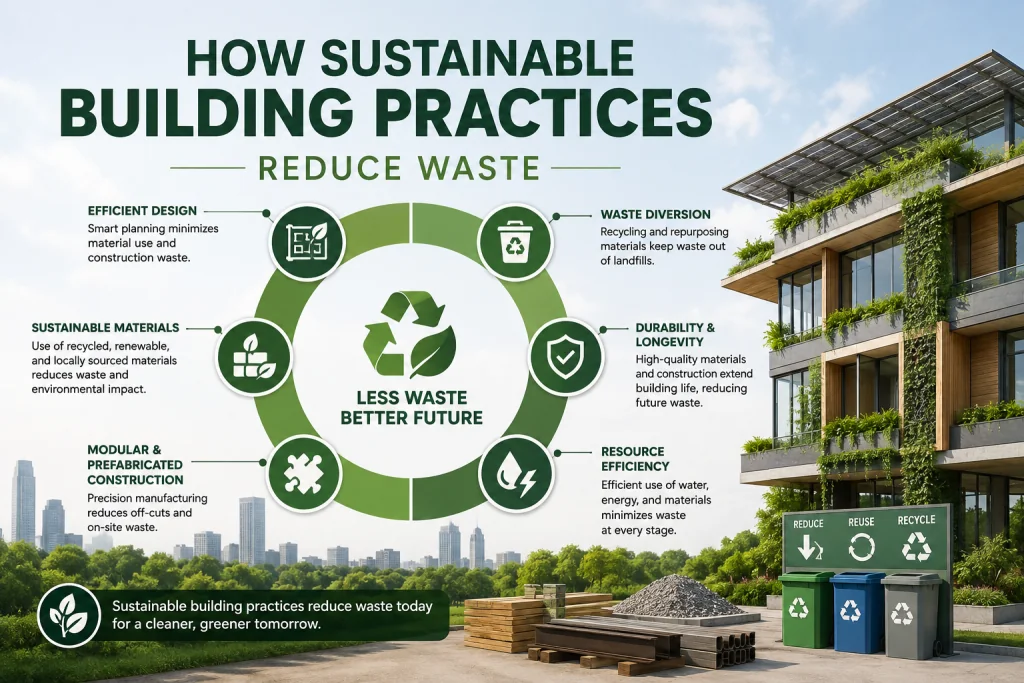
How Do Sustainable Building Practices Reduce Waste?
How Do Sustainable Building Practices Reduce Waste?
Meta Description: Discover how sustainable building practices reduce waste in the construction industry. Learn how a deep understanding of environmental impact drives smarter design, material selection, and on-site execution.
Target Audience: Construction professionals, developers, architects, and project managers.
The construction industry has long held a notorious reputation for resource consumption. Historically, building sites have been synonymous with excess: mountains of timber offcuts, discarded packaging, and demolished structures destined for the landfill. In fact, construction and demolition (C&D) debris account for a staggering portion of global solid waste.
However, a paradigm shift is underway. Driven by stricter environmental regulations, corporate ESG (Environmental, Social, and Governance) goals, and a growing understanding of environmental impact, the industry is rapidly adopting sustainable building practices.
But how exactly do these practices reduce waste? To answer this, we must first look at the macro-environmental impact of construction waste, and then explore the micro-level strategies used on the job site to mitigate it.
The "Why": Understanding the Environmental Impact of Construction Waste
Before implementing sustainable practices, industry professionals must cultivate a deep environmental impact understanding. It is not just about keeping the site clean; it is about recognizing the lifecycle consequences of the materials we use.
When we send construction waste to a landfill, the environmental impact is threefold:
- Embodied Carbon Loss: The energy used to extract, manufacture, and transport materials is wasted. When materials are discarded, the carbon emitted during their creation is essentially "spent" for no long-term utility.
- Resource Depletion: Virgin materials (like sand, timber, and minerals) are finite. Wasting them accelerates the depletion of natural ecosystems.
- Toxic Leaching and Emissions: Decomposing organic materials in landfills produce methane, a potent greenhouse gas. Meanwhile, treated woods, paints, and solvents can leach harmful chemicals into the soil and groundwater.
By understanding these impacts, construction leaders can transition from a "take-make-dispose" linear model to a circular economy, where waste is designed out of the system entirely.
1. Prevention by Design: BIM and DfD
The most effective way to reduce waste is to prevent it before ground is even broken. Sustainable building practices heavily emphasize the pre-construction phase.
- Building Information Modeling (BIM): Advanced 3D modeling allows architects and engineers to detect clashes and calculate exact material quantities. This precision drastically reduces the over-ordering of materials and minimizes on-site cutting and offcuts.
- Design for Deconstruction (DfD): Sustainable buildings are designed with their end-of-life in mind. By using mechanical fasteners (bolts and screws) instead of chemical adhesives or welds, buildings can be disassembled rather than demolished. This allows materials to be salvaged and reused in future projects, keeping them out of landfills.
2. Material Selection and the Circular Supply Chain
Understanding environmental impact means looking at Environmental Product Declarations (EPDs) and choosing materials that minimize ecological harm.
- Reclaimed and Recycled Materials: Utilizing reclaimed wood, recycled steel, and crushed concrete for aggregate reduces the demand for virgin resources and diverts existing waste from landfills.
- Just-in-Time (JIT) Delivery: Sustainable site management relies on JIT delivery schedules. By having materials arrive exactly when they are needed, contractors prevent material degradation, weather damage, and theft—common causes of on-site waste.
- Reduced Packaging: Working with suppliers who utilize reusable pallets, minimal packaging, or returnable crates significantly cuts down on the cardboard and plastic waste generated during the procurement phase.
3. On-Site Execution: Prefabrication and Modular Construction
Perhaps the most significant operational shift in reducing construction waste is the move toward off-site construction.
- Factory-Controlled Environments: Prefabrication and modular construction move the building process from a chaotic job site to a controlled factory floor. In a factory, materials can be cut with computer-controlled precision, and offcuts can be immediately sorted and recycled. Studies show that modular construction can reduce material waste by up to 90% compared to traditional site-built methods.
- Reduced Site Disturbance: Modular units require less heavy machinery and fewer temporary site facilities, which reduces the environmental footprint and the waste associated with site preparation.
4. Comprehensive Construction Waste Management Plans (CWMP)
For the waste that is inevitably generated, sustainable practices demand rigorous management. A professional CWMP goes beyond simply throwing everything into a single dumpster.
- Source Separation: Setting up clearly labeled, dedicated bins for wood, metal, concrete, drywall, and plastics ensures that materials are not contaminated and can actually be processed by recycling facilities.
- Waste Audits and Tracking: Using digital waste-tracking software allows project managers to monitor waste generation in real-time. By understanding what is being thrown away, teams can adjust their practices to prevent that specific waste in the next phase of the project.
The Business Case: Sustainability as a Competitive Advantage
For construction professionals, understanding the environmental impact of waste is not just an ecological imperative; it is a financial one.
Reducing waste directly improves the bottom line. Lower material purchasing costs, reduced waste disposal and landfill tipping fees, and increased efficiency all contribute to higher profit margins. Furthermore, as governments and private clients increasingly mandate green building certifications (like LEED, BREEAM, or Green Globes), demonstrating a robust understanding of environmental impact and waste reduction is becoming a prerequisite for winning bids.
The question, "How do sustainable building practices reduce waste?" is ultimately answered through a shift in mindset. By fostering a deep environmental impact understanding, the construction industry can see waste not as an unavoidable byproduct of building, but as a design flaw.
Through precise digital planning, circular material sourcing, off-site prefabrication, and rigorous site management, the industry is proving that we can build the future without burying the past. For construction leaders, the message is clear: sustainable waste reduction is no longer just good for the planet—it is essential for the future of the business.
Found this article valuable?
Share it with fellow builders, architects, or download the QR code.
Written by Shanmugam2026
Verified CreatorARQONZ Editorial Team brings you expert insights, construction guides, and architectural design trends from across the building industry.
Related Articles in Construction

What Should I Never Say to My Contractor?