How Does Green Construction Affect My Property Value?
How Does Green Construction Affect My Property Value?
Meta Description: Discover how green construction impacts property value. Explore the investment ROI, operational savings, and resale advantages of sustainable building for developers and homeowners.
Target Audience: Real estate developers, construction professionals, property investors, and prospective homeowners.
Sustainability in the construction industry is no longer just a passing trend or a moral imperative; it is a fundamental driver of real estate economics. As environmental regulations tighten and buyer preferences shift, the question on the mind of every developer, investor, and homeowner is: How does green construction actually affect my property value?
The short answer is: It significantly increases it.
However, the true financial impact of green building goes far beyond the initial appraisal. To understand the full scope of this value-add, we need to break down the specific investment and resale considerations that make sustainable construction a smart financial strategy.
The "Green Premium": Direct Impact on Property Value
When a building is designed and constructed with sustainable practices—utilizing energy-efficient HVAC systems, high-performance building envelopes, solar readiness, and sustainable materials—it immediately commands a higher market valuation.
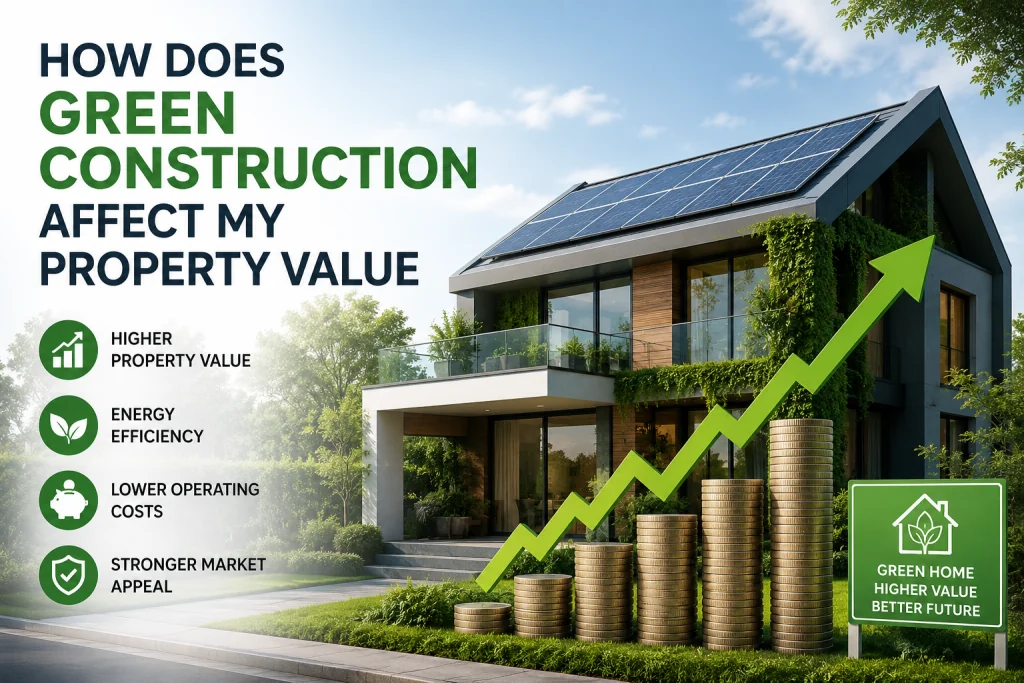
Industry studies consistently show that green-certified buildings (such as LEED, BREEAM, or ENERGY STAR) can command a price premium of 5% to 15% over comparable non-green properties. Appraisers are increasingly using "green addendums" to factor in the long-term operational savings and superior build quality when determining a property's final valuation. Simply put, a green building is appraised not just for its physical footprint, but for its financial efficiency.
Investment Considerations: Maximizing ROI
For investors and developers, the initial capital expenditure (CapEx) of green construction can be slightly higher. However, the return on investment (ROI) is realized through several powerful financial levers:
1. Drastic Reductions in Operational Costs (OpEx)
The most immediate financial benefit of green construction is the reduction in ongoing operational costs. Energy-efficient lighting, smart building management systems, and superior insulation drastically lower utility bills. For commercial properties, this translates to higher Net Operating Income (NOI), which directly increases the property’s capitalization rate and overall value.
2. Tax Incentives and Grants
Governments at the local, state, and federal levels are aggressively incentivizing sustainable construction. Investors can take advantage of tax credits, accelerated depreciation, and rebates for installing renewable energy systems or meeting specific efficiency benchmarks. These incentives can offset the initial green construction premiums, accelerating the payback period.
3. Future-Proofing Against Regulatory Risk
As we move deeper into the 2020s, municipalities are implementing strict building performance standards and carbon emission caps. "Brown" buildings face the risk of stranded assets—properties that become obsolete or require massive, unbudgeted retrofitting to meet new codes. Green construction future-proofs your investment, protecting it from regulatory obsolescence and the associated "brown discounts" in the market.
4. Lower Vacancy and Higher Retention
In the commercial and multi-family residential sectors, green buildings boast lower vacancy rates. Tenants are highly motivated to lease spaces that offer lower utility costs and better indoor environmental quality. This leads to higher tenant retention, reducing the costly turnover and downtime associated with vacant units.
Resale Considerations: Winning Over the Modern Buyer
When it comes time to sell, green construction provides a distinct competitive advantage in the marketplace. Here is how sustainability influences resale velocity and buyer appeal:
1. Faster Time on Market
Properties with verified green credentials sell faster. The pool of eco-conscious buyers is expanding rapidly, driven by Millennials and Gen Z who now make up the largest share of active homebuyers and corporate leasing decision-makers. These demographics prioritize sustainability and are willing to pay a premium for it, reducing the days your property sits on the market.
2. The "Health and Wellness" Selling Point
Modern buyers aren't just looking at the energy bill; they are looking at their health. Green construction heavily emphasizes Indoor Environmental Quality (IEQ)—including advanced air filtration, non-toxic low-VOC materials, and abundant natural daylight. Post-pandemic, these health-centric features have become top-tier selling points that resonate deeply with prospective buyers.
3. Tangible Marketing Assets
A green building gives your marketing team something concrete to sell. Instead of just selling "square footage," you are selling a lifestyle and a financial benefit. You can market the specific HERS (Home Energy Rating System) scores, the projected annual energy savings, and the specific eco-friendly materials used. This transparency builds trust and justifies a higher asking price.
Actionable Advice for Construction Professionals
If you are a builder, developer, or contractor looking to leverage green construction for maximum property value, keep these best practices in mind:
- Pursue Recognized Certifications: Don't just build green; prove it. Third-party certifications like LEED, NGBS (National Green Building Standard), or ENERGY STAR provide the verifiable data that appraisers and buyers demand.
- Focus on the "Invisible" Green: While solar panels are highly visible, the highest ROI often comes from the building envelope, advanced framing, and high-efficiency HVAC. Ensure your foundational systems are top-tier.
- Educate the Buyer/Investor: A green home is only valuable if the buyer understands why. Provide a "green manual" at closing that details the systems installed, maintenance requirements, and projected utility savings.
- Partner with Green-Savvy Appraisers: Ensure the property is appraised by professionals trained in the valuation of green features, so the sustainable upgrades aren't left out of the final valuation.
Green construction is no longer just about saving the planet; it is about protecting and growing your financial assets. By lowering operational costs, mitigating regulatory risks, and appealing to a rapidly growing demographic of eco-conscious buyers, sustainable building directly and positively impacts property value.
Whether you are developing a commercial high-rise or building a custom residential home, integrating green construction principles is one of the smartest investment and resale strategies you can employ.
Found this article valuable?
Share it with fellow builders, architects, or download the QR code.
Written by Shanmugam2026
Verified CreatorARQONZ Editorial Team brings you expert insights, construction guides, and architectural design trends from across the building industry.
Related Articles in Construction

What Should I Never Say to My Contractor?