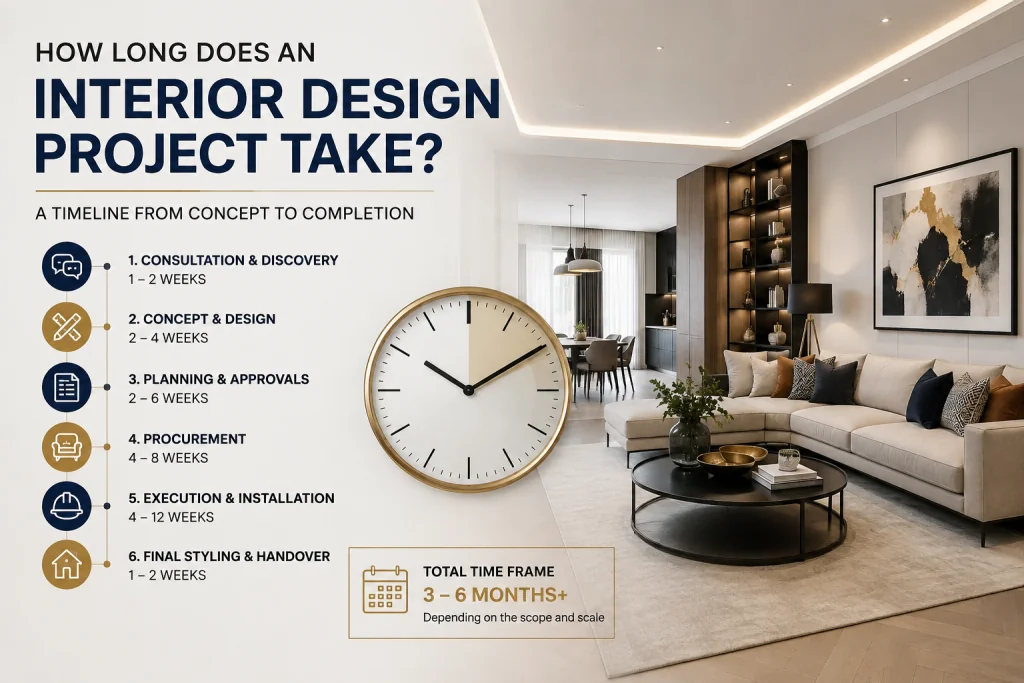
How Long Does an Interior Design Project Take?
How Long Does an Interior Design Project Take?
In the construction and development industry, few questions carry as much weight—or cause as much anxiety—as: "When will this project be finished?"
When it comes to interior design, the answer is rarely a simple number of weeks. The timeline of an interior design project is a complex ecosystem that directly dictates your construction schedule, subcontractor coordination, and ultimately, your return on investment. A delay in the design phase creates a domino effect that can stall the job site, inflate budgets, and strain client relationships.
To keep your projects moving efficiently from concept to completion, construction professionals, project managers, and developers need a clear understanding of interior design timelines. Here is a comprehensive breakdown of what to expect, phase by phase, and how to manage the variables.
The Short Answer: A High-Level Cheat Sheet
Before diving into the granular details, it helps to establish baseline expectations based on project scale. While every project is unique, here is a general rule of thumb for the design-to-build lifecycle:
- Single Room / Cosmetic Refresh: 2 to 4 months
- Full Residential Remodel (Kitchen/Bath/Additions): 6 to 10 months
- Commercial Tenant Improvement (TI) / Office Build-out: 6 to 12 months
- Large-Scale Commercial / Hospitality / Multi-Family: 12 to 24+ months
Note: These timelines include both the pre-construction design phases and the physical construction/implementation.
The Phase-by-Phase Breakdown
To accurately build your Gantt charts and schedule subcontractors, you must understand the distinct phases of the interior design process.
1. Pre-Design & Programming (Weeks 1–3)
Before a single line is drawn, the design team must understand the scope. This phase involves site measuring, client interviews, space planning requirements, and establishing the project budget.
- Construction Impact: Minimal on-site impact, but crucial for accurate estimating and bidding.
2. Schematic Design (SD) (Weeks 4–7)
The designer develops initial concepts, floor plans, and mood boards. This is where the "look and feel" and spatial flow are established.
- Construction Impact: General Contractors (GCs) can begin preliminary estimating and identifying major structural or MEP (Mechanical, Electrical, Plumbing) implications.
3. Design Development (DD) (Weeks 8–12)
The design is refined. Materials, finishes, fixtures, and equipment (FF&E) are selected. The design team begins coordinating with structural engineers and MEP consultants.
- Construction Impact: This is a critical handoff period. GCs should be reviewing DD documents to flag constructability issues and begin preliminary procurement of long-lead items.
4. Construction Documents (CD) (Weeks 13–18)
The design team produces the highly detailed, technical drawings required for pricing, permitting, and actual construction. This includes reflected ceiling plans, electrical layouts, millwork details, and finish schedules.
- Construction Impact: This is the most critical phase for the construction team. Incomplete or conflicting CDs are the number one cause of RFIs (Requests for Information) and change orders during the build.
5. Procurement, Permitting, & Bidding (Weeks 19–24+)
While the design team finalizes FF&E orders and the permitting team submits plans to the city, the GC finalizes bids, locks in subcontractors, and orders materials.
- Construction Impact: Supply chain realities dictate this phase. Custom millwork, specialized glass, or imported stone can have lead times of 12 to 20 weeks.
6. Construction & Installation (Months 6–12+)
The physical build begins. Demolition, framing, MEP rough-ins, drywall, finishes, and finally, the installation of the FF&E.
- Construction Impact: This is where the design vision becomes reality. The timeline here is heavily dependent on the efficiency of the previous phases and the reliability of the supply chain.
4 Variables That Derail the Timeline
Even the most meticulously planned schedules face friction. As a construction professional, you must anticipate and mitigate these common timeline killers:
- Client Indecision and Scope Creep: When clients change their minds after the Construction Documents (CD) phase, it forces redesigns, halts procurement, and requires re-sequencing the job site.
- Material Lead Times: The post-pandemic supply chain has stabilized, but custom and international materials still require significant lead times. Failing to order early can stall the critical path.
- Permitting and Zoning Delays: Municipal review times are notoriously unpredictable. A delayed building permit means delayed mobilization for your subcontractors.
- Unforeseen Site Conditions: Especially in renovations, opening up walls can reveal outdated MEP systems or structural deficiencies that require immediate redesign and engineering approvals.
How Construction Pros Can Keep the Schedule on Track
Managing the timeline is a collaborative effort between the design team, the client, and the construction team. Here is how GCs and Project Managers can protect the schedule:
- Implement Early Contractor Involvement (ECI): Bring the GC on board during the Design Development phase. Constructability reviews at this stage prevent costly redesigns during the CD phase.
- Establish a "Design Freeze" Date: Work with the client and designer to establish a hard date after which no design changes will be accepted without a formal change order and schedule extension.
- Front-Load Procurement: Identify long-lead items (HVAC units, custom elevators, specialty glazing) during the DD phase and issue early purchase orders to get them in the queue.
- Build Buffer Time into the Critical Path: Never schedule subcontractors back-to-back with zero margin for error. A 10% time contingency in your master schedule can absorb minor delays without derailing the final handover.
Answering the question, "How long does an interior design project take?" requires looking beyond the aesthetic vision and focusing on the logistical reality.
By understanding the sequential phases of interior design, anticipating supply chain and permitting variables, and fostering tight collaboration between the design and construction teams, project managers can set realistic expectations. Ultimately, a well-managed timeline doesn't just save time—it protects profit margins, ensures quality craftsmanship, and delivers a finished space that exceeds client expectations.
Found this article valuable?
Share it with fellow builders, architects, or download the QR code.
Written by Shanmugam2026
Verified CreatorARQONZ Editorial Team brings you expert insights, construction guides, and architectural design trends from across the building industry.
Related Articles in Construction

What Should I Never Say to My Contractor?