How Long Until Sustainable Building Pays for Itself?
How Long Until Sustainable Building Pays for Itself?
For decades, the construction and real estate development industries have wrestled with a persistent question: Sustainable building is great for the planet, but when does it make financial sense for the bottom line?
Historically, green building was viewed as a "nice-to-have" feature that required a massive upfront capital expenditure (CapEx) with vague long-term returns. Today, that narrative has flipped. With rising energy costs, stringent environmental regulations, and tenant demands for eco-friendly spaces, sustainable construction is no longer just an ethical choice—it is a financial imperative.
But for developers, contractors, and investors, the ultimate question remains: How long until a sustainable building pays for itself?
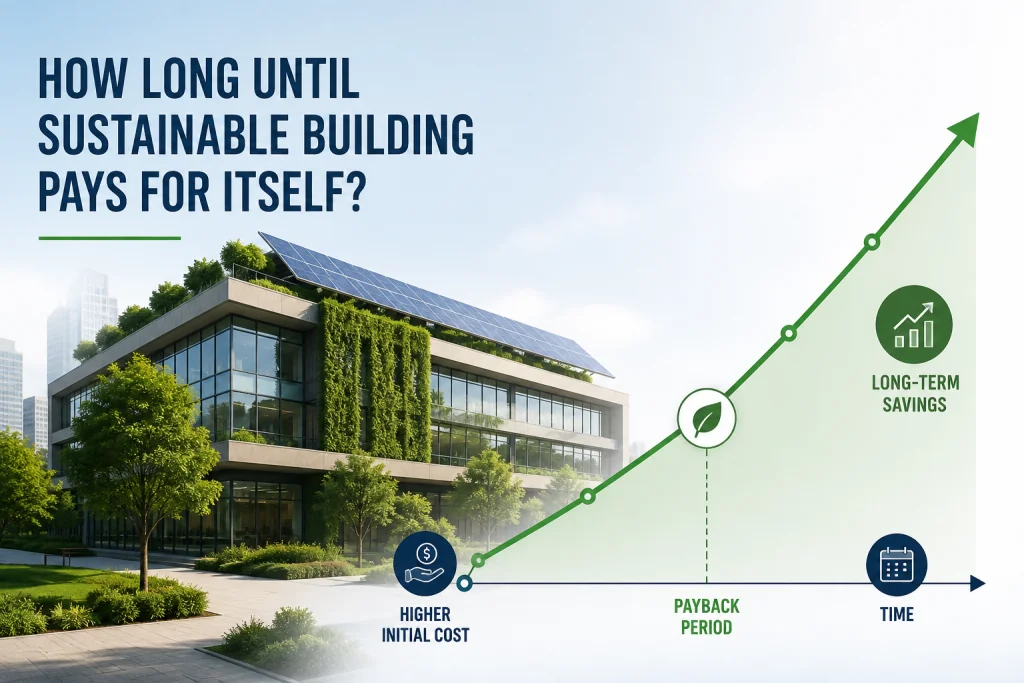
To answer this, we need to look past the initial price tag and dive into the metrics that matter: Payback Period and Break-Even Analysis.
Defining the Metrics: Payback vs. Break-Even
Before looking at the timelines, it is crucial to understand how the industry measures financial recovery in sustainable construction.
1. The Simple Payback Period
This is the most straightforward metric. It calculates how many years it will take for the operational savings (reduced energy, water, and maintenance costs) to equal the initial "green premium" (the extra upfront cost of sustainable materials and technologies).
- Formula: Initial Additional Investment ÷ Annual Operational Savings = Payback Period (in years).
2. Break-Even Analysis (Lifecycle Costing)
While simple payback is useful, it ignores the time value of money. A comprehensive break-even analysis looks at the Net Present Value (NPV) and Internal Rate of Return (IRR) over the building’s entire lifecycle. It factors in inflation, discount rates, maintenance schedules, and eventual asset resale value. This tells you the exact moment the project transitions from a net negative to a net positive cash flow.
The Numbers: How Long Does It Actually Take?
The timeline for breaking even varies wildly depending on the scope of the sustainable interventions. Here is what current industry data tells us:
1. Targeted Energy Efficiency Upgrades (3 to 7 Years)
If you are integrating specific high-ROI technologies—such as advanced HVAC systems, high-performance building envelopes, LED lighting with smart sensors, or low-flow water fixtures—the payback period is remarkably short. Because these systems drastically reduce daily operational expenses (OpEx), they typically pay for themselves in 3 to 7 years.
2. Whole-Building Green Certification (5 to 10 Years)
Aiming for certifications like LEED, BREEAM, or WELL usually incurs a "green premium" of 2% to 5% above standard construction costs. However, when you combine utility savings with reduced maintenance and higher rental premiums, the break-even point for whole-building sustainability generally lands between 5 and 10 years. After this point, the building is generating pure financial alpha.
3. On-Site Renewable Energy (Solar & Storage) (5 to 12 Years)
The cost of commercial solar PV and battery energy storage systems (BESS) has plummeted over the last decade. Depending on local utility rates and net-metering policies, on-site renewables typically see a simple payback in 5 to 12 years, after which the energy generated is essentially free for the remaining 15-to-25-year lifespan of the equipment.
4. Deep Energy Retrofits (7 to 15 Years)
For existing buildings undergoing massive overhauls to meet modern net-zero standards, the payback period is longer due to the sheer scale of the CapEx. However, the break-even point is almost always achieved before the building requires its next major capital cycle.
4 Factors That Accelerate Your Break-Even Point
If you want to push your sustainable project toward the faster end of the payback spectrum, consider these four variables during the pre-construction phase:
- Local Energy Costs: The higher the local cost of electricity and water, the faster your sustainable systems will pay for themselves. A high-performance envelope in a region with expensive grid power will break even much faster than in a region with subsidized, cheap energy.
- Government Incentives and Tax Credits: Don't leave money on the table. Federal, state, and local incentives (such as the Inflation Reduction Act tax credits in the US, or local green grants) can instantly shave 20% to 30% off your initial CapEx, drastically shortening the payback period.
- Building Typology: Buildings with high baseline energy demands—such as data centers, hospitals, and large commercial offices—will see a much faster ROI on sustainable tech than low-energy buildings like warehouses.
- Integrated Design: The biggest mistake developers make is treating sustainability as an afterthought. When architects, engineers, and contractors collaborate from Day 1 (Integrated Project Delivery), they can optimize the building's orientation and massing, often reducing the required size (and cost) of mechanical systems.
Beyond the Break-Even: The "Hidden" ROI of Green Building
If you only calculate the break-even point based on utility bills, you are undervaluing the asset. Once a sustainable building passes its break-even threshold, it unlocks secondary financial benefits that compound over time:
- The "Green Premium" on Asset Value: Sustainable buildings consistently command higher resale values. Studies show that LEED or BREEAM-certified buildings can sell for a 5% to 15% premium over comparable non-certified assets.
- Lower Vacancy Rates: Corporate tenants with their own ESG (Environmental, Social, and Governance) mandates are actively seeking green spaces. Sustainable buildings experience lower vacancy rates and can command higher rents per square foot.
- Regulatory Future-Proofing: As cities implement strict carbon caps and penalize high-emitting buildings (e.g., Local Law 97 in New York), sustainable buildings avoid massive future fines and the need for emergency, expensive retrofits.
- Occupant Productivity: While harder to quantify on a balance sheet, better indoor air quality and natural lighting have been proven to reduce absenteeism and boost productivity, making your building highly attractive to premium corporate tenants.
The question is no longer if sustainable building pays for itself, but how quickly you can get to the break-even point.
By shifting the industry mindset from short-term CapEx minimization to long-term lifecycle value maximization, developers and contractors can deliver projects that are not only environmentally responsible but financially superior. A 5-to-10-year payback period is a highly attractive investment horizon in real estate—especially when the returns continue to compound for the next 50 years.
Found this article valuable?
Share it with fellow builders, architects, or download the QR code.
Written by Shanmugam2026
Verified CreatorARQONZ Editorial Team brings you expert insights, construction guides, and architectural design trends from across the building industry.
Related Articles in Construction

What Should I Never Say to My Contractor?