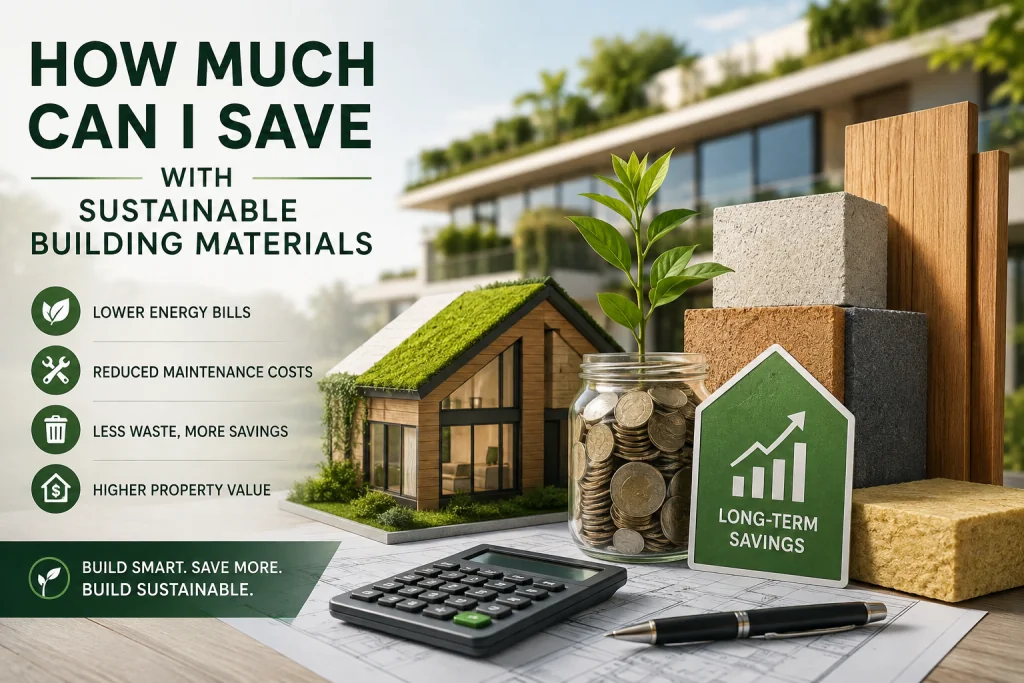
How Much Can I Save With Sustainable Building Materials?
How Much Can I Save With Sustainable Building Materials?
Meta Description: Discover the true financial impact of sustainable building materials. We break down cost comparisons, lifecycle savings, and realistic ROI expectations for construction professionals.
For decades, the construction industry has operated under a persistent misconception: going green means going over budget.
While it is true that certain sustainable materials carry a higher initial price tag, the narrative around green building has fundamentally shifted. Today, with stricter environmental regulations, advanced manufacturing, and a growing demand for energy-efficient spaces, sustainable building materials are no longer just an ethical choice—they are a financial strategy.
For contractors, developers, and project managers, the critical question is no longer "Is it eco-friendly?" but rather, "How much can I save, and what is the ROI?"
Here is a comprehensive breakdown of cost comparisons, hidden savings, and realistic ROI expectations when integrating sustainable materials into your next project.
The Paradigm Shift: First Cost vs. Lifecycle Cost
To understand the savings, construction professionals must first shift their estimating mindset from First Cost (the initial price of materials and installation) to Lifecycle Cost Analysis (LCCA) (the total cost of ownership, including maintenance, energy, and replacement over the building's life).
When evaluating sustainable materials, the savings rarely come from the initial material receipt. Instead, the ROI is realized through operational efficiency, reduced construction waste, labor savings, and increased asset valuation.
Cost Comparison: Traditional vs. Sustainable Materials
Let’s look at how common sustainable alternatives compare to traditional materials in terms of upfront costs and long-term value.
1. Concrete: Traditional Portland vs. Green Concrete (Fly Ash/Slag/Carbon-Injected)
- Upfront Cost: Green concrete mixes can be 5% to 15% more expensive per cubic yard than traditional Portland cement.
- The Savings: Green concrete often utilizes industrial byproducts (like fly ash) which can be cheaper to source locally, offsetting transport costs. More importantly, carbon-injected concrete increases compressive strength, allowing engineers to use less material overall. Furthermore, it future-proofs the project against impending carbon taxes and embodied carbon regulations.
2. Framing: Traditional Stick-Built Timber vs. Mass Timber (CLT) or Prefab Panels
- Upfront Cost: Mass timber (Cross-Laminated Timber) can carry a 10% to 20% material premium over standard light-gauge steel or traditional lumber.
- The Savings: Massive labor and time savings. Mass timber and prefab sustainable panels are manufactured off-site with high precision. This reduces on-site construction time by up to 30% to 50%, drastically cutting labor costs, crane rental fees, and general conditions. It also reduces on-site waste disposal fees by up to 80%.
3. Insulation: Fiberglass Batts vs. Mineral Wool or Bio-Based Spray Foam
- Upfront Cost: High-performance sustainable insulation can cost 15% to 30% more upfront.
- The Savings: Superior thermal performance and air sealing reduce the required size and capacity of HVAC systems. Downsizing HVAC equipment can save 10% to 20% on mechanical costs, which often pays for the insulation premium before the building is even occupied.
4. Roofing: Asphalt Shingles vs. Cool Roofs / Standing Seam Metal
- Upfront Cost: Metal or "cool" reflective roofing can cost 2x to 3x more than asphalt.
- The Savings: Asphalt roofs last 15–20 years; metal roofs last 40–60 years. When factoring in the avoided cost of a mid-life roof replacement, reduced cooling loads (up to 15% energy savings), and lower maintenance, the lifecycle cost of sustainable roofing is significantly lower.
Where Do the Actual Savings Come From? (The ROI Drivers)
When pitching sustainable materials to a client or evaluating a bid, highlight these four pillars of ROI:
1. Construction Phase Savings (Builder ROI)
- Waste Reduction: Sustainable building emphasizes precision and prefabrication. Reducing material waste by 30% directly lowers purchasing costs and eliminates expensive dumpster hauling and landfill tipping fees.
- Faster Build Times: Materials like Insulated Concrete Forms (ICF) and prefab timber panels go up faster, reducing overhead and financing costs during the construction phase.
2. Operational Savings (Owner ROI)
- Energy & Water: High-performance envelopes, smart glass, and low-flow fixtures reduce utility bills by 20% to 40%. For commercial tenants, this is a massive operational savings that justifies higher lease rates.
3. Financial Incentives and Grants
- Governments and municipalities are heavily subsidizing green building. Utilizing sustainable materials can unlock tax credits, density bonuses, expedited permitting, and rebates (such as those found in the US Inflation Reduction Act or local green building grants), which can instantly recoup 10% to 30% of the material premium.
4. Increased Asset Value and Marketability
- Buildings constructed with sustainable materials and certified under LEED, BREEAM, or WELL command higher market values. Studies consistently show that green-certified commercial buildings enjoy rent premiums of 3% to 7% and higher occupancy rates compared to non-certified peers.
Realistic ROI Expectations and Timelines
So, what are the actual numbers you can expect to see on a pro forma?
- Initial Premium: Expect an overall project cost increase of 1% to 5% when integrating a comprehensive suite of sustainable materials.
- Payback Period: For commercial projects, the energy and operational savings typically result in a payback period of 3 to 7 years.
- Long-Term ROI: Over a 20-year lifecycle, the ROI on sustainable building features generally ranges from 15% to over 40%, depending on local energy costs and the specific materials used.
- Maintenance ROI: Sustainable, durable materials (like metal roofing, composite decking, or fiber-cement siding) reduce lifecycle maintenance and replacement costs by 20% to 50%.
Strategic Advice for Construction Firms
To successfully capture these savings, construction firms must adapt their workflows:
- Update Your Estimating Software: Ensure your estimating tools are updated to reflect the current market rates of sustainable materials and the localized labor savings they provide.
- Educate the Client Early: Do not wait until the value-engineering phase to discuss green materials. Introduce Lifecycle Cost Analysis (LCCA) during the pre-construction phase to align the owner’s expectations.
- Build Local Supply Chains: The "sustainability" of a material is negated if it has to be shipped across the globe. Source local sustainable materials to reduce transport costs and carbon footprints.
- Track and Document: To claim tax incentives and certifications, meticulous documentation of material sourcing and waste diversion is required. Implement digital tracking from day one.
The question "How much can I save with sustainable building materials?" does not have a single, simple answer, because the savings are distributed across the entire lifecycle of the building.
While you may pay a slight premium on day one, the compounding returns—realized through reduced labor, lower waste disposal, minimized HVAC loads, tax incentives, and higher property values—make sustainable materials one of the smartest financial investments in modern construction.
In today’s market, building sustainably isn’t just about saving the planet; it’s about protecting your profit margins.
Found this article valuable?
Share it with fellow builders, architects, or download the QR code.
Written by Shanmugam2026
Verified CreatorARQONZ Editorial Team brings you expert insights, construction guides, and architectural design trends from across the building industry.
Related Articles in Construction

What Should I Never Say to My Contractor?