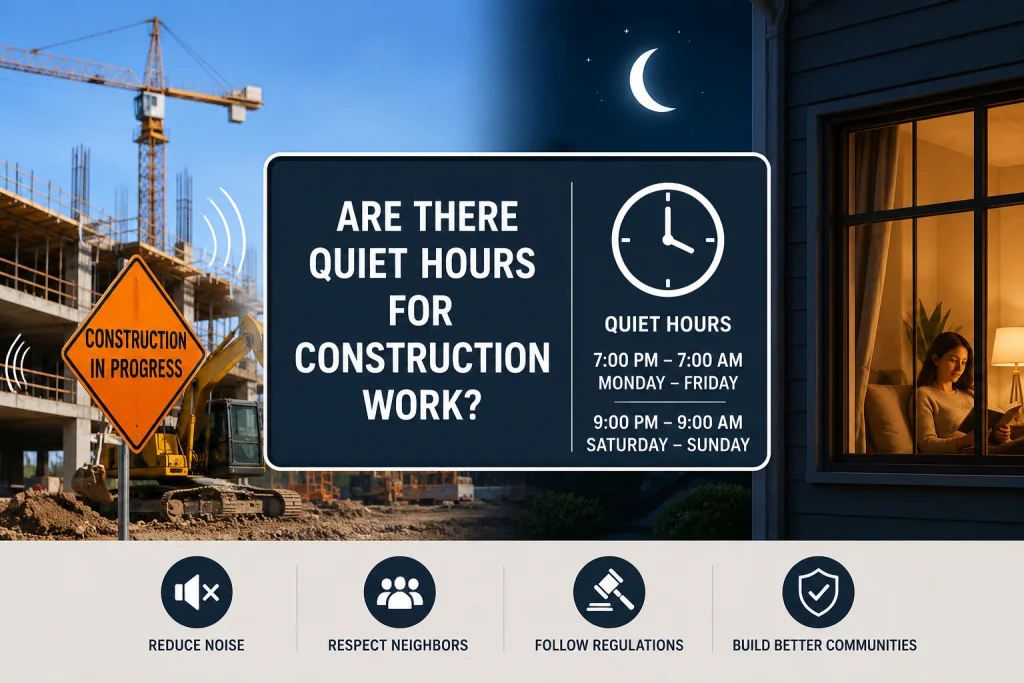
Is Construction Allowed Before 7am?
Is Construction Allowed Before 7am?
Meta Description: Wondering if construction is allowed before 7 AM? Learn how to navigate early morning work restrictions, noise ordinances, and how to keep your project on schedule without violating local codes.
Suggested Featured Image: A split image showing a construction site at dawn on one side, and a close-up of a municipal codebook or a noise decibel meter on the other.
It’s a familiar scenario for every project manager and site superintendent: The schedule is tight, the critical path is unforgiving, and the crew is ready to go. But it’s only 5:30 AM. Can you fire up the equipment and get to work, or do you need to wait?
The question we get asked most frequently in the industry is: "Is construction allowed before 7 AM?"
The short answer is: Usually no, but it entirely depends on your local municipality, the zoning of your site, and the specific type of work being performed.
Understanding and navigating early morning work restrictions is no longer just about being a good neighbor; it is a critical component of risk management, budget control, and professional site administration. Here is everything construction professionals need to know about early morning work restrictions.
The "7 AM Rule": Understanding Local Noise Ordinances
In many major cities and suburban municipalities across the US, UK, and Canada, 7:00 AM is the standard legal start time for construction activities in residential zones.
However, treating 7 AM as a universal rule is a dangerous assumption for contractors. Early morning work restrictions are governed by local noise ordinances, which can vary drastically from one city to the next—and sometimes from one neighborhood to the next.
Zoning Matters
- Residential Zones: Typically the most restrictive. Standard allowed hours are usually 7:00 AM to 6:00 PM or 8:00 PM on weekdays, with even stricter limits on weekends and holidays.
- Commercial Zones: Often allow earlier starts, sometimes as early as 6:00 AM.
- Industrial Zones: May permit 24/7 construction operations, provided decibel limits at the property line are respected.
It’s Not Just About Time; It’s About Decibels
Many modern municipalities are moving away from strict time-based bans and are instead using decibel (dB) limits. Even if your local code allows work to start at 6:00 AM, if your equipment exceeds the legal decibel limit at the nearest property line, you are in violation.
Why Do Early Morning Restrictions Exist?
Municipalities enforce these restrictions to balance economic development with the health and safety of the community. Early morning construction disrupts sleep patterns, impacts nearby schools and hospitals, and generally degrades the quality of life for residents.
For contractors, ignoring these restrictions doesn't just upset the community; it invites the wrath of local code enforcement.
The Cost of Non-Compliance
Pushing the boundaries of early morning work restrictions is a high-risk gamble. If a resident calls in a noise complaint, the consequences can severely impact your project's bottom line:
- Stop-Work Orders: The most devastating penalty. A single stop-work order can delay your critical path by days, costing thousands in idle labor and equipment.
- Fines and Penalties: Municipal fines for noise ordinance violations can range from a few hundred to several thousand dollars per occurrence.
- Reputational Damage: A strained relationship with the community and local inspectors can make future permitting and variance approvals much more difficult.
How to Legally Navigate Early Morning Work
If your project schedule absolutely demands an early start, you don't necessarily have to halt operations. Here is how professional contractors navigate early morning restrictions legally and efficiently:
1. Apply for a Noise Variance or Special Permit
Most cities have a process for applying for a noise variance. If you can prove that early work is necessary for a specific, time-sensitive reason (e.g., a continuous concrete pour, critical highway lane closures, or mitigating an emergency), the city may grant a temporary permit. Pro tip: Apply well in advance and offer a detailed community mitigation plan.
2. Implement "Quiet Work" Phasing
If you are allowed on site before 7 AM (or if you are working in a commercial zone with an early start), strictly manage the type of work being done.
- Before 7 AM: Limit activities to quiet tasks like interior layout, painting, material staging, or manual labor.
- After 7 AM: Schedule high-decibel activities like jackhammering, heavy equipment operation, and steel erection.
3. Invest in Noise Mitigation
If you must work early, invest in temporary noise mitigation. This includes acoustic blankets on chain-link fences, using equipment with factory-installed noise-reduction mufflers, and positioning noisy equipment away from the nearest property lines.
4. Proactive Community Relations
Never let the community find out about early work from the sound of a backup alarm. Distribute flyers, hold town hall meetings, and set up a dedicated hotline for complaints. When residents feel informed and respected, they are significantly less likely to call code enforcement.
So, is construction allowed before 7 AM? Never assume it is.
As construction professionals, our job is to build the future without disrupting the present. Before mobilizing your crew for an early shift, always verify the specific municipal code for your exact site location. Factor the legal working hours into your baseline schedule during the pre-construction phase, and build strong relationships with local inspectors before you ever need to ask them for a favor.
By respecting early morning work restrictions, you protect your profit margins, keep your schedule intact, and maintain the professional reputation of your firm
Found this article valuable?
Share it with fellow builders, architects, or download the QR code.
Written by Shanmugam2026
Verified CreatorARQONZ Editorial Team brings you expert insights, construction guides, and architectural design trends from across the building industry.
Related Articles in Construction

What Should I Never Say to My Contractor?