What Decibel Level Is Construction Noise Usually?
What Decibel Level Is Construction Noise Usually?
Meta Description: Discover the typical decibel levels of construction noise, understand OSHA loudness measurements, and learn how to protect your crew and community.
If there is one universal truth in the construction industry, it’s that building the future is loud. But when it comes to site safety, regulatory compliance, and community relations, "loud" isn't a measurable metric. To manage noise effectively, construction professionals need to speak the language of sound: Decibels (dB).
Understanding construction noise levels isn’t just about avoiding OSHA fines; it’s about protecting your crew’s long-term hearing, optimizing site efficiency, and maintaining good relations with the surrounding community.
Here is a comprehensive guide to understanding loudness measurements and the typical decibel levels you will encounter on the job site.
The Science of Sound: How the Decibel Scale Works
Before looking at specific numbers, it is crucial to understand how the decibel scale operates. The dB scale is logarithmic, not linear. This means that a small numerical increase represents a massive jump in actual sound energy.
- A 3 dB increase doubles the acoustic energy (sound pressure).
- A 10 dB increase is perceived by the human ear as being twice as loud.
Therefore, a piece of equipment operating at 95 dB isn't just slightly louder than one at 85 dB—it is perceived as four times louder and carries significantly more acoustic energy.
Typical Construction Noise Levels by Equipment
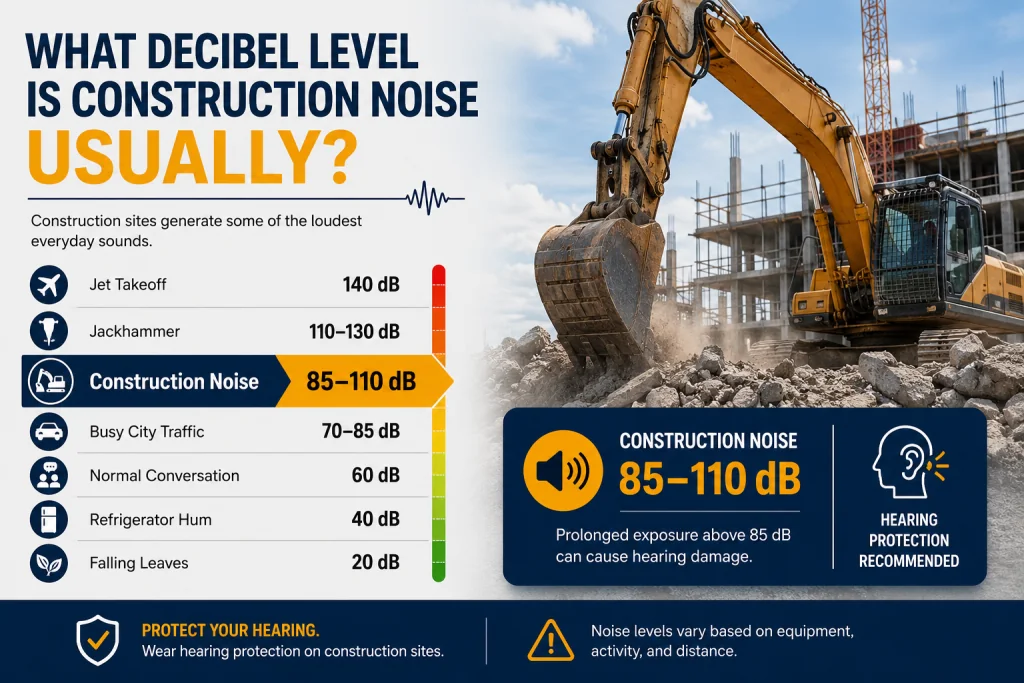
Noise levels on a construction site vary wildly depending on the phase of the project and the equipment being used. Here are the typical decibel ranges measured at the operator’s ear level or at the source:
1. Heavy Earthmoving and Lifting Equipment (80 – 95 dB)
- Bulldozers and Loaders: 85 – 93 dB
- Excavators: 80 – 90 dB
- Cranes: 80 – 85 dB
- Note: Modern, enclosed cabs with climate control can significantly reduce the operator's exposure to these baseline levels.
2. Power Tools and Handheld Equipment (90 – 115 dB)
- Circular Saws and Grinders: 95 – 110 dB
- Concrete Mixers: 85 – 95 dB
- Nail Guns (Pneumatic): 100 – 115 dB (Impulse noise)
- Chainsaws: 100 – 110 dB
3. High-Impact and Demolition Work (100 – 130+ dB)
- Jackhammers / Pavement Breakers: 100 – 115 dB
- Plate Compactors: 95 – 105 dB
- Pile Drivers: 110 – 130+ dB
- Explosives / Blasting: 130 – 140+ dB (Strictly regulated impulse noise)
The Regulatory Thresholds: OSHA and Hearing Conservation
In the United States, the Occupational Safety and Health Administration (OSHA) sets strict guidelines for noise exposure in construction (29 CFR 1926.52). Understanding these thresholds is mandatory for any site safety plan.
- 85 dB (The Action Level): If a worker’s Time-Weighted Average (TWA) exposure reaches 85 dB over an 8-hour shift, the employer must implement a Hearing Conservation Program. This includes baseline audiometric testing, annual hearing checks, and providing hearing protection.
- 90 dB (The Permissible Exposure Limit - PEL): This is the absolute maximum noise level a worker can be exposed to over an 8-hour shift without hearing protection.
- The 5 dB Exchange Rate: Under OSHA rules, for every 5 dB increase over 90 dB, the permissible exposure time is cut in half. (e.g., At 95 dB, a worker can only be exposed for 4 hours; at 100 dB, only 2 hours). Note: NIOSH recommends a stricter 3 dB exchange rate for optimal safety.
- 140 dB (Peak Limit): For impulse or impact noise (like nail guns or blasting), the peak sound pressure level must never exceed 140 dB.
Beyond the Site: Community Noise Ordinances
Worker safety is only half the equation. Construction managers must also navigate municipal noise ordinances to avoid work stoppages and fines.
While OSHA regulates the worker's ear, local city councils regulate the property line.
- Typical Municipal Limits: Most urban areas restrict construction noise to 55 dB to 75 dB measured at the nearest residential property line.
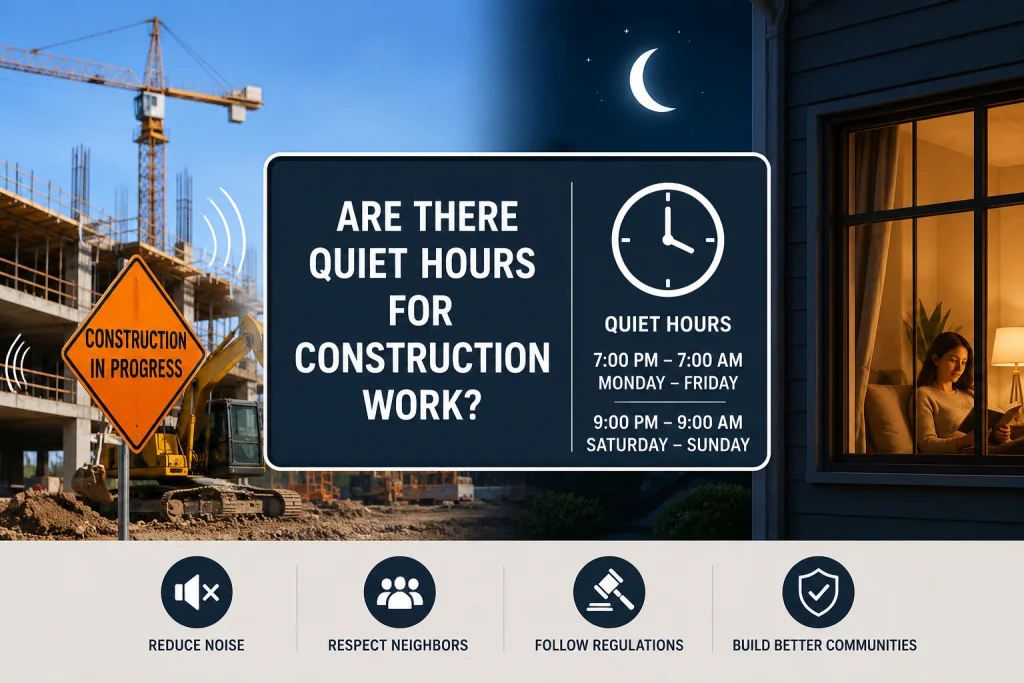
- Time Restrictions: Many cities prohibit high-decibel work before 7:00 AM or after 6:00 PM, and on weekends.
Pro Tip: Always check local municipal codes before breaking ground. Failing to monitor property-line decibel levels can result in severe fines and damaged relationships with the public.
4 Best Practices for Managing Site Noise
As a construction professional, you can’t eliminate noise, but you can mitigate it. Implement these strategies to keep your site compliant and safe:
- Conduct Noise Monitoring: Don't guess; measure. Use calibrated sound level meters or dosimeters to map the noise zones on your site. Identify "red zones" where dB levels exceed 85 dB.
- Implement Engineering Controls: Before relying on PPE, try to reduce the noise at the source. Use acoustic blankets around perimeter fencing, maintain equipment regularly (a poorly lubricated machine is a louder machine), and use tools with built-in mufflers.
- Optimize Administrative Controls: Rotate workers through high-noise tasks to limit individual exposure times. Schedule the loudest activities (like pile driving or concrete breaking) for the middle of the day when community impact is lowest.
- Enforce Proper PPE: Personal Protective Equipment is the last line of defense. Ensure all workers in high-decibel zones are using earplugs or earmuffs with an appropriate Noise Reduction Rating (NRR). Make sure the PPE is comfortable, or workers won't wear it correctly
Understanding decibel levels and loudness measurements is a hallmark of a professional, forward-thinking construction firm. By accurately measuring noise, respecting OSHA thresholds, and mitigating community impact, you protect your most valuable asset—your workforce—while ensuring your project runs smoothly from the first shovel to the final walkthrough
Found this article valuable?
Share it with fellow builders, architects, or download the QR code.
Written by Shanmugam2026
Verified CreatorARQONZ Editorial Team brings you expert insights, construction guides, and architectural design trends from across the building industry.
Related Articles in Construction

What Should I Never Say to My Contractor?