What Incentives and Rebates Are Available for Green Construction?
What Incentives and Rebates Are Available for Green Construction?
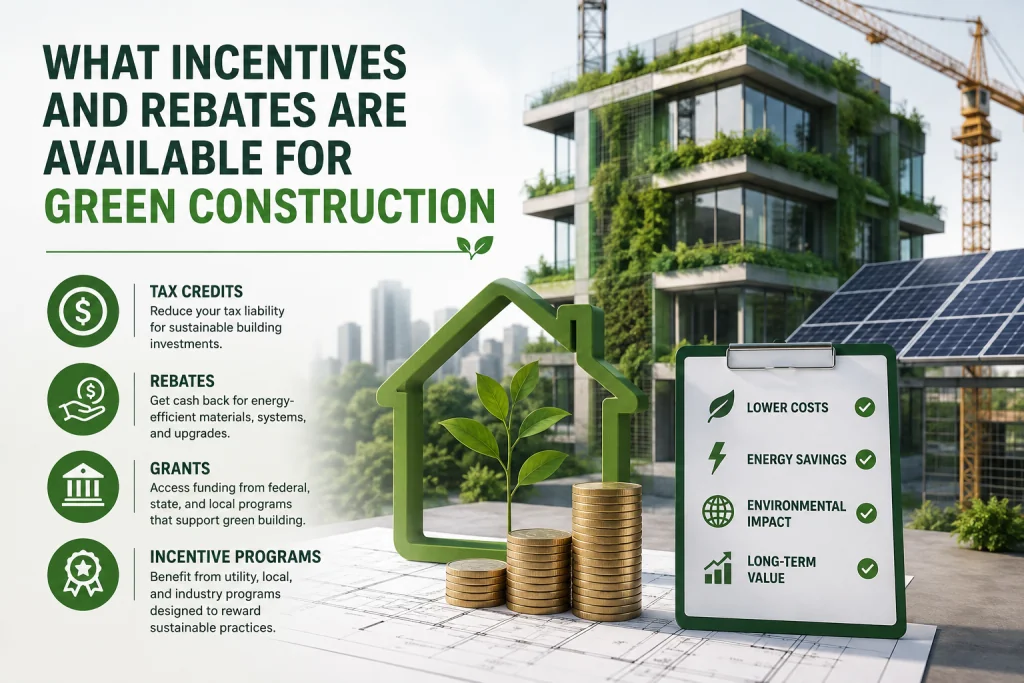
The construction industry is undergoing a massive paradigm shift. Sustainable building is no longer just a niche trend or a marketing gimmick; it is a fundamental business imperative. From reducing operational costs to meeting stringent new environmental regulations, green construction is the future of the built environment.
However, for developers, contractors, and project owners, the "green premium"—the perceived higher upfront capital expenditure (CapEx) of sustainable materials and technologies—remains a primary concern.
The good news? You don’t have to absorb those costs alone. Governments, municipalities, and utility companies are heavily subsidizing the transition to sustainable building. If you are asking, "What incentives and rebates are available for green construction?" this guide will break down the landscape, with a special focus on the financial assistance and grants that can make your next project both eco-friendly and highly profitable.
The Landscape of Green Construction Incentives
Before diving into direct financial assistance, it is important to understand the broader ecosystem of green building incentives. These generally fall into three categories:
- Tax Credits and Deductions: Federal and state tax incentives (such as the 179D Commercial Buildings Energy-Efficiency Tax Deduction in the U.S.) that directly reduce tax liability for achieving specific energy reductions.
- Utility Rebates: Cash-back programs offered by local water and power companies for installing high-efficiency HVAC systems, smart lighting, low-flow plumbing, and on-site renewable energy.
- Zoning and Density Bonuses: Municipal incentives that allow developers to build taller, denser, or with reduced parking requirements if the project achieves certifications like LEED, BREEAM, or local green building standards.
While tax credits and rebates are excellent for improving project margins, they often require the project to be completed and operational before you see the financial return. This is where financial assistance and grants become a game-changer for your cash flow during the construction phase.
Deep Dive: Financial Assistance and Grants for Green Construction
Financial assistance and grants are non-repayable funds or highly subsidized capital provided by government agencies, green banks, and non-profit organizations to de-risk and accelerate sustainable construction. Here is how construction professionals can leverage them:
1. Federal and State Direct Grants
Direct grants provide upfront, non-repayable cash to offset the costs of specific green technologies or sustainable practices.
- Technology-Specific Grants: Agencies like the Department of Energy (DOE) and the Environmental Protection Agency (EPA) frequently offer grants for the integration of advanced building technologies, such as geothermal heat pumps, high-performance building envelopes, and smart grid-integrated solar arrays.
- Affordable Housing Green Grants: Many state and local housing finance agencies offer substantial grants to developers who commit to building or retrofitting affordable housing to green standards (e.g., Enterprise Green Communities or local equivalents).
- Electrification and Decarbonization Grants: With the push to eliminate natural gas in new construction, many jurisdictions now offer direct grants to builders who install all-electric appliances and induction stoves in new residential and commercial builds.
2. Green Banks and Subsidized Financing
While not strictly "free money," green banks provide financial assistance in the form of low-interest loans, loan guarantees, and credit enhancements specifically tailored for green construction.
- C-PACE (Commercial Property Assessed Clean Energy): This allows commercial property owners to finance 100% of the costs of energy efficiency, renewable energy, and water conservation improvements. The financing is repaid as a special assessment on the property’s tax bill, and the obligation transfers to the new owner if the property is sold.
- Green Bank Loan Loss Reserves: State-level green banks often partner with local lenders to provide construction loans at below-market interest rates for projects that meet strict sustainability benchmarks.
3. Technical Assistance and Pre-Development Grants
One of the hidden costs of green construction is the design and engineering phase. Energy modeling, sustainability consulting, and specialized architectural design cost more upfront.
- Pre-Development Grants: Many municipal sustainability offices offer grants specifically to cover the "soft costs" of green building. This includes paying for LEED accreditation, third-party energy modeling, and lifecycle cost analyses.
- Free Technical Consulting: Local green building councils and utility providers often provide free technical assistance to help construction teams identify the most cost-effective energy-saving measures during the design phase.
How Construction Firms Can Maximize Grant and Incentive Opportunities
Securing financial assistance requires more than just filling out a form; it requires strategic planning. Here is how your construction firm can ensure you capture every available dollar:
- Integrate Sustainability in Pre-Construction: Incentives are often tied to early design decisions. Bring your sustainability consultant and energy modeler on board during the pre-construction phase to design specifically for grant eligibility.
- Track and Document Everything: Grant providers and tax credit auditors require rigorous proof of performance. Implement strict commissioning processes and maintain meticulous documentation of material sourcing, energy modeling, and equipment installations.
- Stack Your Incentives: The most profitable green projects "stack" incentives. For example, a project might use a state grant for pre-development, a utility rebate for high-efficiency HVAC, a federal tax credit for the solar array, and a municipal density bonus to add extra rentable square footage.
- Stay Updated on Legislation: The landscape of green funding changes rapidly. With the ongoing rollout of major climate and infrastructure legislation, billions of dollars in new grants are being distributed through 2026 and beyond. Assign a team member or hire a consultant dedicated to tracking these funding opportunities.
The question isn't just what incentives and rebates are available for green construction; it's how your firm can strategically position itself to capture them. By leveraging financial assistance and grants, construction companies can significantly reduce the upfront capital required for sustainable building, mitigate financial risk, and deliver higher ROI to their clients
Found this article valuable?
Share it with fellow builders, architects, or download the QR code.
Written by Shanmugam2026
Verified CreatorARQONZ Editorial Team brings you expert insights, construction guides, and architectural design trends from across the building industry.
Related Articles in Construction

What Should I Never Say to My Contractor?