What Sustainable Flooring Options Won't Break the Bank?
What Sustainable Flooring Options Won't Break the Bank?
In today’s construction industry, project managers and contractors are frequently caught in a familiar tug-of-war: clients and developers are demanding sustainable, LEED- or WELL-certified building materials, but they are simultaneously enforcing strict, bottom-line budgets.
For years, "green building" carried a premium price tag. But as supply chains have matured and manufacturing processes have scaled, the gap between eco-friendly and cost-effective has closed. You no longer have to sacrifice your profit margins—or your client’s budget—to specify sustainable materials.
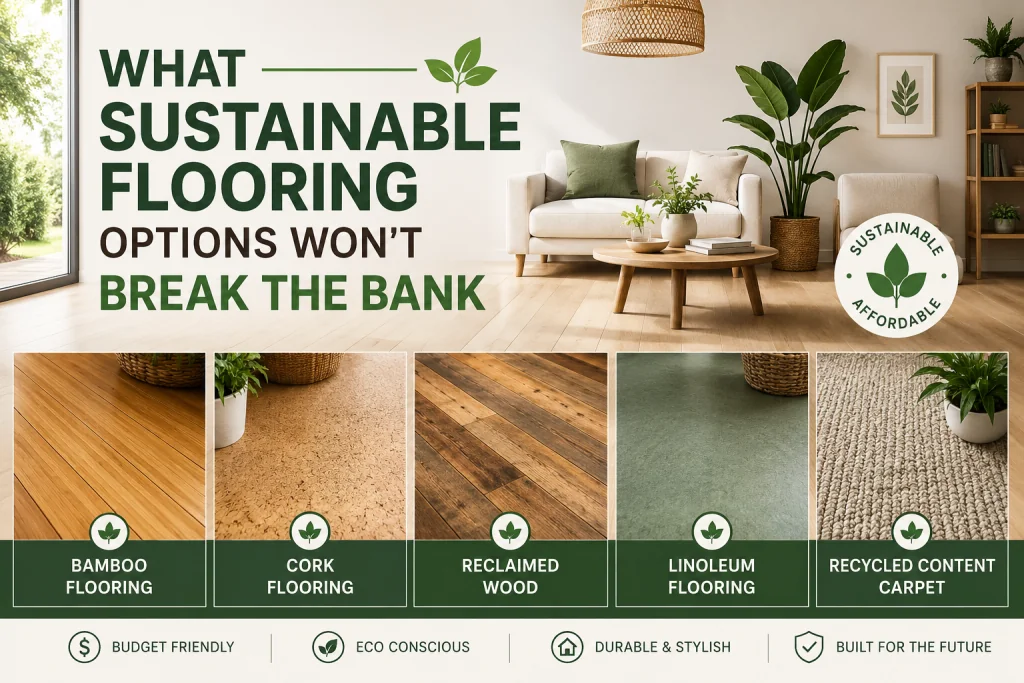
Here is a breakdown of the most reliable, affordable, and sustainable flooring options that deliver high performance without breaking the bank, perfect for your next residential or commercial build.
1. Polished Concrete: The Ultimate "Hidden" Green Floor
When discussing affordable sustainable flooring, the best option is often the one that is already there. For slab-on-grade construction, polished concrete is an unbeatable green choice.
- The Sustainability Factor: It utilizes the existing structural slab, eliminating the need for additional material extraction, manufacturing, and transportation. It also has high thermal mass, which can help regulate indoor temperatures and reduce HVAC loads. Furthermore, it requires no VOC-emitting adhesives or synthetic sealants if a densifier is used.
- The Budget Advantage: While the labor for grinding and polishing requires skilled trades, you are entirely eliminating the material cost of a secondary floor covering.
- Best Applications: Commercial spaces, retail, modern residential builds, and industrial-style lofts.
2. Strand-Woven Bamboo: The Hardwood Alternative
Bamboo has been a staple in green building for years, but strand-woven bamboo is the specific product you want to specify for high-traffic areas.
- The Sustainability Factor: Unlike hardwood trees that take decades to mature, bamboo is a rapidly renewable grass that reaches harvestable maturity in 3 to 5 years.
- The Budget Advantage: Strand-woven bamboo is compressed with resins under extreme heat, making it roughly twice as hard as traditional red oak. It offers the premium aesthetic and durability of high-end hardwood at a mid-tier price point, typically ranging from $3 to $6 per square foot for materials.
- Best Applications: Residential builds, light commercial spaces, and office interiors. (Pro-tip: Ensure you specify low-VOC adhesives for installation to maintain indoor air quality).
3. True Linoleum (Marmoleum): The Commercial Workhorse
First, let’s clear up a common industry misconception: Linoleum is not vinyl. Vinyl (LVT/LVP) is a synthetic PVC product. True linoleum is a biobased material made from solidified linseed oil, pine rosin, ground cork dust, wood flour, and pigments, pressed onto a jute backing.
- The Sustainability Factor: It is made from natural, renewable, and abundant raw materials. It is naturally antimicrobial, biodegradable, and boasts incredibly low VOC emissions.
- The Budget Advantage: While the upfront material cost is slightly higher than basic VCT (Vinyl Composition Tile), linoleum’s lifecycle cost is vastly superior. It can last 30 to 40 years with proper maintenance and doesn't require the constant stripping and waxing that VCT demands, saving massive amounts in long-term facility management costs.
- Best Applications: Healthcare facilities, educational institutions, commercial kitchens, and high-traffic public corridors.
4. Cork: The Acoustic and Thermal Specialist
Cork is harvested from the bark of the cork oak tree. The tree is not cut down; the bark is simply stripped and regenerates over nine years, making it a brilliantly renewable resource.
- The Sustainability Factor: The harvesting process actually increases the tree's ability to absorb CO2. Cork flooring is also naturally hypoallergenic, antimicrobial, and provides excellent natural insulation.
- The Budget Advantage: Cork is highly cost-effective, especially when factoring in its secondary benefits. In multi-family residential builds, cork’s natural acoustic dampening properties can help projects easily meet strict Impact Insulation Class (IIC) and Sound Transmission Class (STC) code requirements without the need to buy and install expensive, separate acoustic underlayments.
- Best Applications: Multi-family residential, home offices, libraries, and senior living facilities.
5. Recycled Carpet Tiles: The Modular Commercial Solution
For commercial projects requiring soft flooring, traditional broadloom carpet is a thing of the past. Recycled carpet tiles (often made from PET plastics or recycled nylon) are the modern standard.
- The Sustainability Factor: Many major manufacturers now produce tiles using up to 100% recycled content, and they offer take-back programs to recycle old tiles into new ones, keeping them out of landfills.
- The Budget Advantage: Carpet tiles offer a massive lifecycle ROI. If a stain or wear pattern occurs in broadloom, you replace the whole room. With tiles, you simply pull up and replace the 2x2 or 2x4 damaged squares. This drastically reduces long-term maintenance and replacement costs for the building owner.
- Best Applications: Corporate offices, hospitality, and modular commercial workspaces.
Contractor Pro-Tips for Specifying Green Flooring
To successfully integrate these materials into your projects, keep the following in mind:
- Pitch Lifecycle Costing (LCC): Clients often fixate on the initial install price. Educate them on LCC. Show them how polished concrete or linoleum saves them money on maintenance, replacement, and energy costs over a 10-year period.
- Verify the Certifications: "Greenwashing" is rampant. Always specify products that carry rigorous, third-party certifications like FloorScore, GREENGUARD Gold, or FSC (Forest Stewardship Council) to ensure you are actually hitting your LEED or WELL building credit targets.
- Factor in the Subfloor: Sustainable materials like bamboo and linoleum require a perfectly flat, dry, and stable subfloor. Budget for proper subfloor prep (like self-leveling underlayment) to prevent premature wear or installation failure.
Sustainability and affordability are no longer mutually exclusive in the construction industry. By understanding the lifecycle value and proper applications of materials like polished concrete, strand-woven bamboo, true linoleum, cork, and recycled carpet tiles, you can deliver high-performance, eco-friendly builds that satisfy both the client’s conscience and their bottom line.
Found this article valuable?
Share it with fellow builders, architects, or download the QR code.
Written by Shanmugam2026
Verified CreatorARQONZ Editorial Team brings you expert insights, construction guides, and architectural design trends from across the building industry.
Related Articles in Construction

What Should I Never Say to My Contractor?