What Technology Do Professional Contractors Use Daily?
What Technology Do Professional Contractors Use Daily?
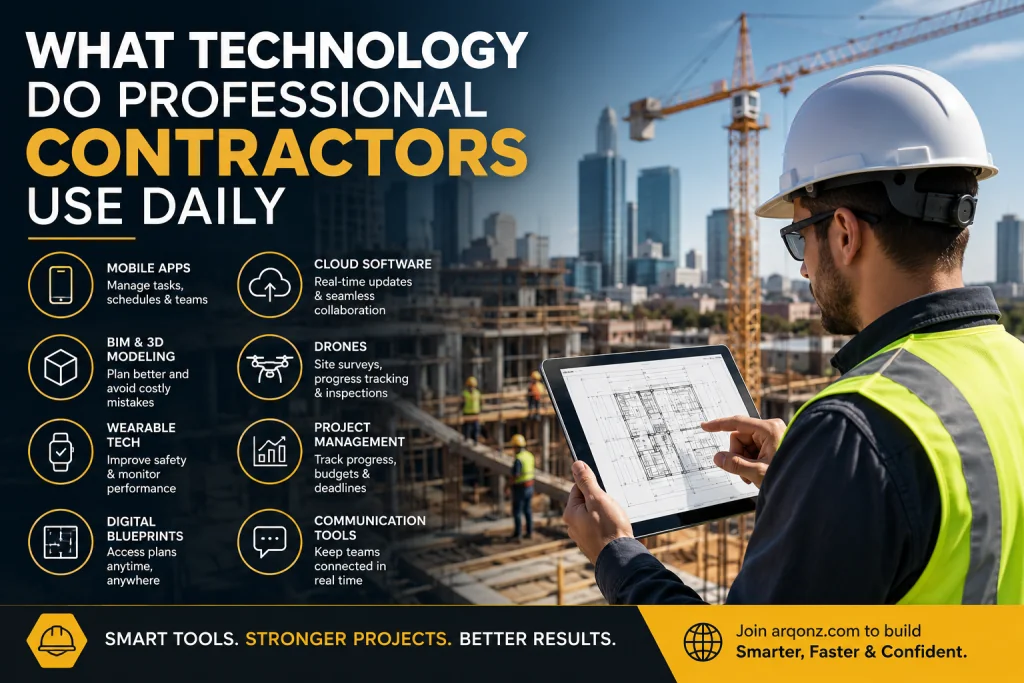
In today's rapidly evolving construction industry, the difference between thriving and surviving often comes down to one factor: technology adoption. While hard hats and blueprints remain staples on job sites, professional contractors are increasingly relying on sophisticated digital tools to streamline operations, improve accuracy, and boost profitability.
But what exactly are successful contractors using on a daily basis? Let's explore the essential technologies that are transforming the construction landscape.
1. Project Management Software
Gone are the days of scattered spreadsheets and endless email chains. Modern contractors depend on comprehensive project management platforms like:
- Procore - Centralized project documentation and collaboration
- Buildertrend - Residential construction management
- PlanGrid - Blueprint management and field collaboration
- Autodesk Construction Cloud - Enterprise-level project coordination
These platforms enable real-time communication between office staff and field crews, ensuring everyone works from the same updated information.
2. Building Information Modeling (BIM)
BIM software has revolutionized how contractors plan and execute projects:
- Autodesk Revit - 3D modeling and design coordination
- Navisworks - Clash detection and project review
- Trimble Connect - BIM data collaboration
By creating detailed digital representations of physical structures, contractors can identify potential issues before they become costly problems on-site.
3. Mobile Field Applications
The job site is no longer disconnected from the office. Mobile apps empower field teams with:
- Digital daily logs and progress tracking
- Photo documentation with geotagging
- Time tracking and labor management
- Safety inspection checklists
- RFI (Request for Information) submission and tracking
Popular choices include Raken, Fieldwire, and Assignar, which work seamlessly offline and sync when connectivity is restored.
4. Drone Technology
Unmanned Aerial Vehicles (UAVs) have become indispensable for:
- Site surveys and topographical mapping
- Progress monitoring with aerial photography
- Safety inspections of hard-to-reach areas
- Stockpile measurements and volume calculations
- Marketing documentation showcasing project milestones
Contractors use drones equipped with high-resolution cameras and LiDAR sensors to capture data that would be time-consuming or dangerous to collect manually.
5. Estimating and Takeoff Software
Accurate bidding is the foundation of profitable contracting. Modern estimating tools include:
- PlanSwift - Digital takeoff and estimating
- Sage Estimating - Comprehensive cost management
- Bluebeam Revu - PDF markup and quantity takeoff
- Stack - Cloud-based estimating platform
These solutions reduce human error, speed up the bidding process, and provide detailed documentation to support quotes.
6. Accounting and Financial Management
Keeping projects profitable requires real-time financial visibility:
- QuickBooks Online - General accounting integration
- Sage 100 Contractor - Industry-specific financial management
- Xero - Cloud-based accounting
- Foundation Software - Construction-focused ERP
These platforms integrate with project management tools to provide accurate job costing, cash flow forecasting, and financial reporting.
7. Equipment and Fleet Management
Contractors with substantial equipment investments rely on:
- GPS tracking systems for location and utilization monitoring
- Telematics for maintenance scheduling and fuel management
- Equipment sharing platforms to optimize asset usage
- Preventive maintenance software to reduce downtime
Solutions like Trimble Earthworks, Cat Connect, and Fleetio help maximize equipment ROI.
8. Communication and Collaboration Tools
Clear communication prevents costly mistakes. Essential tools include:
- Slack or Microsoft Teams for instant messaging
- Zoom for virtual meetings with clients and stakeholders
- WhatsApp Business for quick field communications
- Procore Field Productivity for structured team coordination
9. Wearable Technology and Safety Tech
Worker safety is paramount, and technology is making job sites safer:
- Smart helmets with sensors and communication systems
- Wearable devices that monitor vital signs and detect falls
- Exoskeletons to reduce physical strain
- IoT sensors for hazardous condition monitoring
10. 3D Printing and Prefabrication
Forward-thinking contractors are embracing:
- 3D printing for rapid prototyping and component fabrication
- Modular construction techniques with precise digital planning
- Robotic equipment for repetitive tasks like bricklaying or concrete pouring
Integration is Key
The most successful contractors don't just adopt technology—they integrate it. The goal is creating a seamless digital ecosystem where:
✓ Data flows automatically between systems
✓ Field and office teams access the same information
✓ Decisions are based on real-time data
✓ Productivity increases while errors decrease
Getting Started with Construction Technology
Feeling overwhelmed? You don't need to implement everything at once. Start by:
- Identifying pain points in your current workflow
- Researching solutions that address those specific challenges
- Starting small with one or two platforms
- Training your team thoroughly before expanding
- Measuring results and adjusting your approach
Found this article valuable?
Share it with fellow builders, architects, or download the QR code.
Written by Shanmugam2026
Verified CreatorARQONZ Editorial Team brings you expert insights, construction guides, and architectural design trends from across the building industry.
Related Articles in Construction

What Should I Never Say to My Contractor?