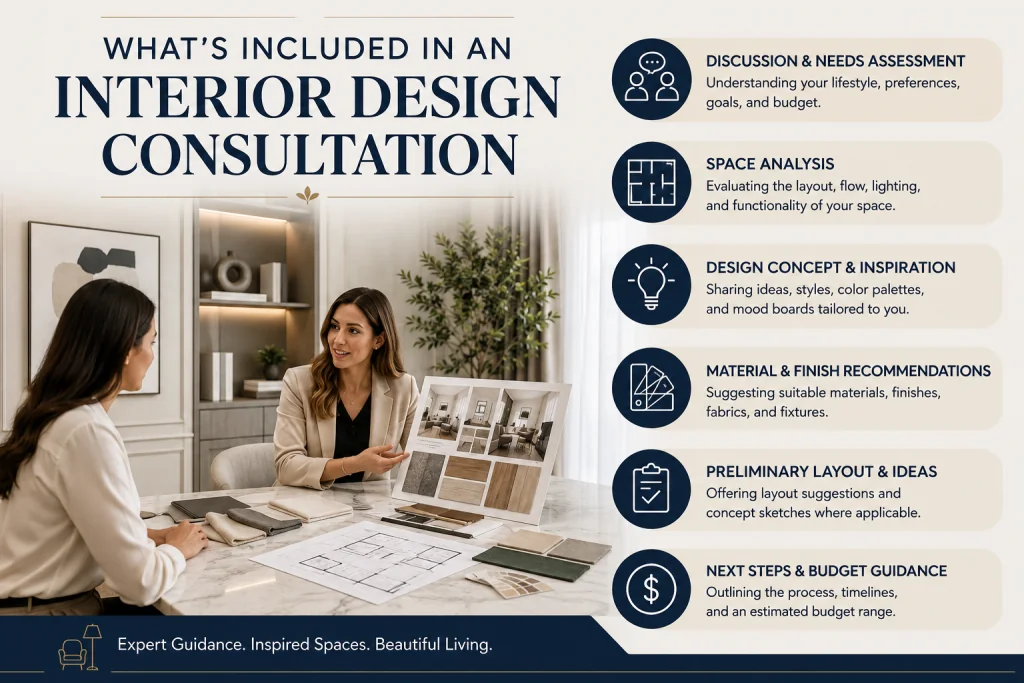
What's Included in an Interior Design Consultation?
What's Included in an Interior Design Consultation?
Meta Description: Discover what happens during an interior design consultation and how understanding these initial design services can help construction professionals streamline projects, reduce change orders, and improve design-build collaboration.
Target Audience: General Contractors, Project Managers, Builders, and Construction Executives.
In the construction industry, the success of a project is often determined long before the first piece of heavy equipment arrives on site. For commercial build-outs, multi-family developments, and high-end residential projects, the intersection of design and construction is where budgets are made or broken.
As a construction professional, you don’t need to be an interior designer, but you do need to understand the design process. Specifically, understanding what is included in an interior design consultation and the scope of initial design services is critical for accurate bidding, constructability reviews, and seamless project execution.
Here is a professional breakdown of what happens during the initial interior design consultation phase, and why it matters to your construction team.
1. The Purpose of the Initial Consultation
The initial interior design consultation is the foundational discovery phase of a project. For the design team, it is about translating the client’s vision into a tangible spatial plan. For the construction team, understanding this phase is about identifying the project scope, potential roadblocks, and baseline budget.
During this phase, the designer is not just picking out finishes; they are assessing the physical realities of the space, evaluating structural limitations, and establishing the project’s critical path.
2. What is Actually Included in the Consultation?
When a client engages an interior designer for initial services, several key deliverables are generated. As a contractor or builder, you should be aware of the following components:
A. Space Planning and Programming
The designer will conduct a "programming" session to determine how the space will be used. This includes calculating square footage requirements, traffic flow, and spatial adjacencies.
- Construction Impact: This dictates the initial framing, partition layouts, and door placements. Understanding the space plan early allows your estimating team to accurately quantify drywall, framing lumber, and door hardware.
B. Preliminary Material and Finish Selection
Initial consultations involve selecting the core palette of materials—flooring, wall treatments, ceiling systems, and cabinetry.
- Construction Impact: This is where supply chain and lead-time realities come into play. A designer might specify a custom imported tile or a specialized acoustic ceiling panel. Knowing these selections early allows your procurement team to check material availability and factor lead times into the construction schedule.
C. MEP (Mechanical, Electrical, and Plumbing) Coordination
While interior designers aren't engineers, their initial layouts heavily influence MEP routing. They will determine the placement of lighting fixtures, power outlets, HVAC diffusers, and plumbing fixtures based on the aesthetic and functional layout.
- Construction Impact: This is crucial for your subcontractors. Early alignment prevents the dreaded "clash detection" issues on site, ensuring that a beautiful custom light fixture doesn’t end up directly in the path of an HVAC duct.
D. Budgeting and Cost Estimating
A professional initial consultation includes establishing a realistic budget. The designer will provide preliminary cost estimates for finishes, fixtures, and furniture (FF&E), as well as the construction costs required to achieve the look.
- Construction Impact: This gives the general contractor a clear financial target. It allows your estimating team to perform preliminary value engineering before the drawings are 100% complete, rather than having to cut costs via change orders mid-construction.
3. How Construction Teams Benefit from Early Involvement
In a traditional Design-Bid-Build model, contractors are often brought in only after the design consultation and schematic design phases are complete. However, the most successful construction firms advocate for early involvement during these initial design services. Here is why:
- Constructability Reviews: By reviewing the initial design concepts, your superintendents and project managers can identify structural or logistical issues. For example, if a designer wants to move a plumbing stack, the construction team can immediately advise on the structural implications and cost.
- Accurate Bidding: Understanding the depth of the initial design services helps contractors write tighter scopes of work. It reduces the "gray areas" that typically lead to scope creep and disputed change orders.
- Streamlined Permitting: Initial design services often include preliminary code compliance checks. When contractors and designers collaborate early, they ensure the design aligns with local building codes, zoning laws, and ADA requirements, resulting in a much faster permitting process.
4. Best Practices for Contractor-Designer Collaboration
To get the most out of the initial design consultation phase, construction professionals should foster a collaborative relationship with the design team.
- Attend the Initial Walkthroughs: If possible, have your lead estimator or project manager attend the initial site walk with the interior designer. Seeing the space through the designer's eyes provides invaluable context for your bid.
- Establish a Value Engineering (VE) Mindset: Approach the initial material selections collaboratively. If a specified material is over budget, offer alternative products that meet the same aesthetic and performance criteria without delaying the schedule.
- Clarify the Division of Responsibilities: Early on, establish exactly what is included in the designer's scope versus the contractor's scope. For instance, who is responsible for procuring the FF&E? Who is handling the specialized artwork installation? Clear boundaries prevent duplicated efforts and missed items.
The interior design consultation is much more than a creative exercise; it is the blueprint for the construction phase. By understanding what is included in these initial design services—from space planning and MEP coordination to preliminary budgeting—construction professionals can mitigate risks, improve bid accuracy, and deliver a superior final product.
In today’s complex construction landscape, the firms that bridge the gap between design and build during the earliest phases are the ones that protect their margins and build lasting client relationships.
Found this article valuable?
Share it with fellow builders, architects, or download the QR code.
Written by Shanmugam2026
Verified CreatorARQONZ Editorial Team brings you expert insights, construction guides, and architectural design trends from across the building industry.
Related Articles in Construction

What Should I Never Say to My Contractor?