What's the Difference Between Sustainable and Net-Zero Construction
What's the Difference Between Sustainable and Net-Zero Construction
In the modern construction industry, the pressure to decarbonize and build responsibly has never been higher. As project owners, developers, and contractors navigate an evolving landscape of ESG (Environmental, Social, and Governance) mandates and stricter building codes, two buzzwords dominate the conversation: Sustainable and Net-Zero.
While often used interchangeably in marketing brochures and project pitches, these terms represent fundamentally different approaches to building. Conflating the two can lead to misaligned project goals, budget overruns, and missed compliance targets.
To successfully deliver the buildings of today and tomorrow, construction professionals must understand the nuances between them. Here is a professional breakdown of sustainable versus net-zero construction, and why distinguishing between these similar concepts is critical for your next project.
Sustainable Construction: The Holistic Philosophy
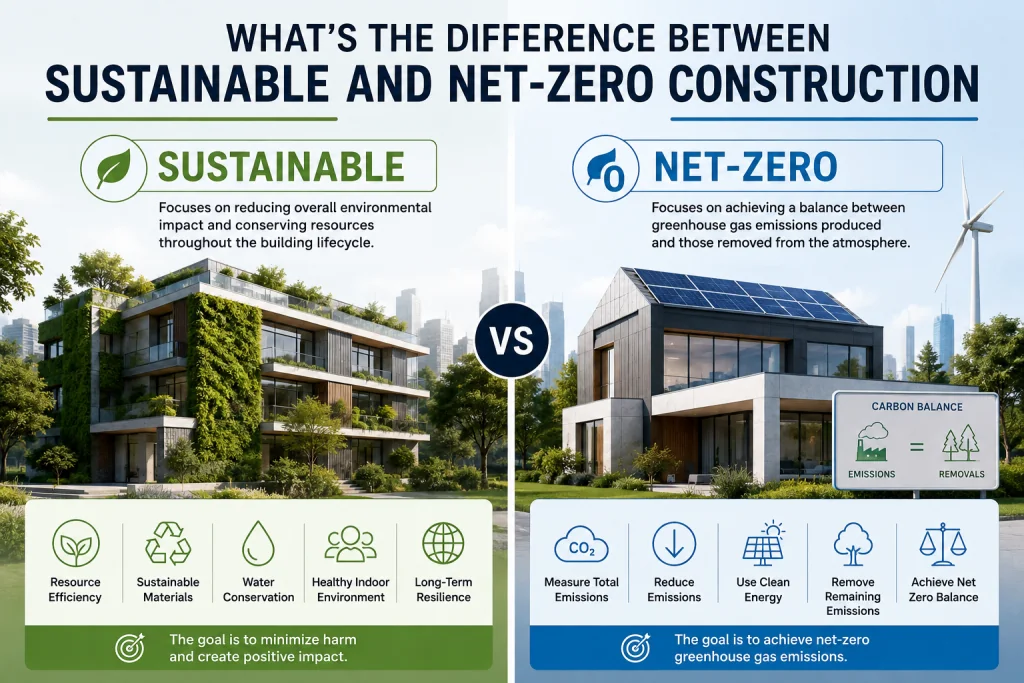
Sustainable construction is a broad, holistic philosophy. It focuses on minimizing the overall negative environmental impact of a building throughout its entire lifecycle—from material extraction and construction to operation and eventual demolition.
Think of sustainable construction as a spectrum. It is about doing less harm and creating a positive balance across multiple pillars of development.
Key Characteristics of Sustainable Construction:
- Broad Scope: It encompasses environmental, economic, and social factors. It’s not just about carbon; it’s about water conservation, indoor air quality, biodiversity, and community impact.
- Lifecycle Thinking: It utilizes Life Cycle Assessments (LCA) to evaluate the environmental impact of building materials (embodied carbon) and long-term operational efficiency.
- Continuous Improvement: There is no single "finish line." A project can be 20% more sustainable than the baseline, or 50% more.
- Certifications: Projects are typically measured against comprehensive rating systems like LEED, BREEAM, or WELL, which award points across various categories of sustainability.
In short: Sustainable construction is about optimizing the overall health, efficiency, and environmental footprint of a building.
Net-Zero Construction: The Specific Target
Net-zero construction, on the other hand, is a highly specific, measurable goal. It refers to a building that produces zero net greenhouse gas emissions (Net-Zero Carbon) or consumes zero net energy from the grid (Net-Zero Energy) over the course of a year.
If sustainable construction is a spectrum, net-zero is a binary destination. You either hit the target, or you don't.
Key Characteristics of Net-Zero Construction:
- Narrow, Quantifiable Scope: It focuses intensely on a single metric: energy consumption or carbon emissions.
- The "Reduce then Offset" Formula: Achieving net-zero requires a two-step process. First, the building envelope and systems must be hyper-efficient to drastically reduce demand. Second, the remaining energy needs must be met through on-site renewable generation (like solar panels) or verified off-site offsets.
- Operational vs. Embodied:
- Net-Zero Operational Carbon: The building runs on zero net fossil fuels during its daily use.
- Net-Zero Embodied Carbon: The materials used to build it (concrete, steel, etc.) have zero net carbon footprint, often achieved through low-carbon materials and carbon sequestration.
- Strict Metrics: Success is measured in hard numbers, such as Energy Use Intensity (EUI) or kilograms of CO2 equivalent (kgCO2e) per square meter.
In short: Net-zero construction is a precise mathematical threshold where a building's environmental impact in a specific category is entirely neutralized.
Distinguishing the Concepts: A Quick Comparison
To clarify the distinction for your project teams and clients, keep this comparison in mind:
| Feature | Sustainable Construction | Net-Zero Construction |
|---|---|---|
| Primary Focus | Holistic environmental, social, and economic health. | A specific, measurable target for energy or carbon. |
| Measurement | Qualitative and quantitative (e.g., LEED points). | Strictly quantitative (e.g., kWh/m² or kgCO2e/m²). |
| Goal | Continuous improvement and minimizing harm. | Reaching a definitive "zero" balance. |
| Materials | Focuses on recycled content, durability, and low toxicity. | Focuses heavily on low embodied carbon and circularity. |
| Analogy | Eating a balanced, nutritious diet. | Consuming exactly zero grams of added sugar. |
Why This Distinction Matters for Construction Professionals
Understanding the difference between these concepts isn't just an academic exercise; it has real-world implications for how you bid, build, and manage projects.
1. Navigating Procurement and Supply Chain
If a client asks for a "sustainable" building, you have flexibility in how you achieve it. You might prioritize local sourcing to reduce transport emissions, or focus on high-quality indoor air quality. If they ask for a "net-zero carbon" building, your procurement strategy must ruthlessly prioritize low-embodied-carbon materials (like green concrete or mass timber) and precise energy modeling, regardless of other sustainable benefits.
2. Avoiding "Greenwashing" and Managing Risk
As we move through 2026, regulatory scrutiny on green claims is at an all-time high. Marketing a project as "net-zero" when it only features a few sustainable elements (like a green roof and LED lighting) is a fast track to reputational damage and legal liability. Clear terminology protects your firm from accusations of greenwashing.
3. Budgeting and Design Integration
Net-zero buildings often require higher upfront capital for advanced building envelopes, specialized HVAC systems, and on-site renewables. Sustainable buildings can sometimes achieve their goals through passive design and smart material choices without the premium price tag of net-zero technology. Accurately defining the goal early ensures the budget aligns with the client's actual expectations.
Both sustainable and net-zero construction are vital to the future of the built environment, but they are not the same thing. Sustainable construction is the overarching journey of building better, healthier, and more resource-efficient structures. Net-zero is a critical milestone on that journey, representing a hard, measurable commitment to eliminating carbon or energy impact.
As construction leaders, your job is to guide clients through this terminology. By distinguishing between these similar concepts early in the preconstruction phase, you can set accurate budgets, select the right supply chain partners, and ultimately deliver a building that meets both the letter and the spirit of modern environmental demands.
Found this article valuable?
Share it with fellow builders, architects, or download the QR code.
Written by Shanmugam2026
Verified CreatorARQONZ Editorial Team brings you expert insights, construction guides, and architectural design trends from across the building industry.
Related Articles in Construction

What Should I Never Say to My Contractor?