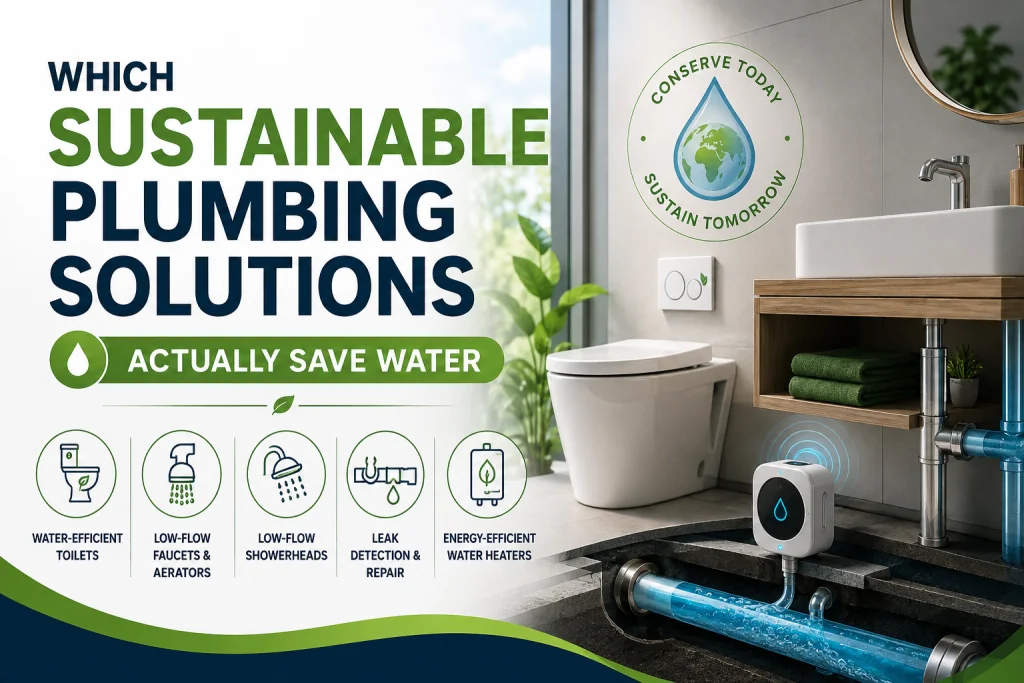
Which Sustainable Plumbing Solutions Actually Save Water?
Which Sustainable Plumbing Solutions Actually Save Water?
As we navigate the mid-2020s, water scarcity is no longer just an environmental talking point—it is a critical operational challenge. For the construction industry, rising municipal water costs, tightening local restrictions, and the growing demand for green building certifications (like LEED and the WELL Building Standard) have made water efficiency a top priority.
But when value-engineering a project, contractors and developers often ask: Which of these "green" plumbing solutions actually save water, and which are just expensive greenwashing?
To build truly sustainable projects, we need to separate the gimmicks from the game-changers. Here is a professional breakdown of the practical water conservation options that deliver measurable, real-world water savings for new builds and major renovations.
1. The Baseline: High-Efficiency Fixtures That Actually Perform
For years, the construction industry hesitated to specify ultra-low-flow fixtures due to complaints about poor performance. Today, advancements in fluid dynamics have solved this. Specifying the right fixtures is the lowest-hanging fruit for water conservation.
- Air-Infused Showerheads and Faucets: Modern aerators mix air into the water stream, maintaining high perceived pressure while drastically reducing flow. Specifying showerheads at 1.5 GPM (Gallons Per Minute) or lower, and lavatory faucets at 0.5 GPM, can reduce fixture water use by 30% to 40% compared to standard code-minimum fixtures, without sacrificing the user experience.
- Dual-Flush and Ultra-High-Efficiency Toilets: While 1.6 GPF (Gallons Per Flush) has been the standard for years, specifying 0.8 to 1.28 GPF dual-flush or pressure-assisted toilets ensures waste is cleared effectively while cutting toilet water usage in half.
- Sensor-Activated Commercial Fixtures: For commercial builds, piezoelectric or infrared sensors with adjustable timeout settings prevent the "phantom flush" and ensure water only runs when actively needed.
2. Beyond the Tap: Greywater and Rainwater Harvesting
If you want to make a massive dent in a building's potable water demand, you have to look beyond the tap. Reusing water on-site is the hallmark of advanced sustainable construction.
- Laundry-to-Landscape Greywater Systems: The most practical entry-point for greywater. By diverting water from washing machines directly to subsurface landscape irrigation, builders can offset outdoor water use without the need for complex permits or extensive plumbing rough-ins (in many jurisdictions).
- Whole-Building Greywater Systems: For larger multi-family or commercial projects, capturing water from showers and sinks, filtering it, and reusing it for toilet flushing or cooling tower make-up water can reduce a building's total potable water demand by 20% to 30%. Pro-tip: Always coordinate early with local plumbing inspectors to ensure compliance with the Uniform Plumbing Code (UPC) or International Plumbing Code (IPC) greywater appendices.
- Rainwater Harvesting: Capturing roof runoff in cisterns for non-potable uses (irrigation, toilet flushing, or even potable use with advanced treatment) is highly effective in regions with distinct wet/dry seasons. It also doubles as a stormwater management solution, helping projects meet municipal runoff requirements.
3. The Silent Water Wasters: Smart Leak Detection
A running toilet or a pinhole slab leak can waste thousands of gallons of water before it is ever noticed. In commercial and multi-family construction, hidden leaks are a massive drain on both water resources and the bottom line.
- IoT Water Monitoring and Auto-Shutoff: Specifying smart water monitoring systems (like Phyn, Moen Flo, or Flume) at the main water meter provides real-time analytics on water usage. More importantly, integrating automatic shut-off valves that trigger when continuous micro-leaks or catastrophic flow rates are detected saves millions of gallons of water annually across a portfolio of buildings, while simultaneously preventing devastating property damage.
4. Stopping the "Wait for Hot Water" Waste
We often focus on the water coming out of the fixture, but we forget the water going down the drain while the user waits for it to get hot. In large homes or commercial buildings, this "cold water sandwich" can waste up to 30% of the water used in a shower.
- Demand-Controlled Hot Water Recirculation: Instead of continuous recirculation (which wastes energy), specify demand-controlled recirculation pumps. These systems use a button, motion sensor, or smart-home integration to push the cold water sitting in the hot water line back into the cold water line or water heater only when the user actually needs hot water. It saves thousands of gallons of wasted water per household, per year.
- Decentralized Tankless Water Heaters: Point-of-use tankless heaters eliminate the long pipe runs associated with centralized systems, drastically reducing the volume of water wasted while waiting for heat.
5. Future-Proofing: Dual Plumbing and "Purple Pipe"
The ultimate practical water conservation option is designing the building to accept non-potable water from day one.
- Purple Pipe Rough-Ins: Even if a municipality does not currently offer reclaimed water, specifying a dual-plumbing system with purple pipe (the universal color code for non-potable water) for toilet flushing and irrigation future-proofs the asset. When the city eventually rolls out a recycled water program, the building is already equipped to tap into it, instantly boosting the property's long-term sustainability and valuation.
Sustainable plumbing is no longer just about checking boxes for a green certification; it is about risk mitigation, reducing municipal impact fees, and delivering lower operating costs to the end-user.
The solutions that actually save water are those that integrate seamlessly into the daily operation of the building without requiring behavioral changes from the occupants. By specifying high-efficiency air-infused fixtures, integrating smart leak detection, designing for greywater reuse, and eliminating "wait-for-hot-water" waste, the construction industry can deliver buildings that are as resource-efficient as they are profitable.
Found this article valuable?
Share it with fellow builders, architects, or download the QR code.
Written by Shanmugam2026
Verified CreatorARQONZ Editorial Team brings you expert insights, construction guides, and architectural design trends from across the building industry.
Related Articles in Construction

What Should I Never Say to My Contractor?